From the Frontlines to COP30 in Belém: Resistance, Resilience, and Climate Justice
Updated: Dec 19, 2025

Welcome to the WECAN COP30 report back. Over the last years, we have received encouraging feedback from many of you that our report-backs from each COP have been useful and important to you, so we are thrilled to be able to offer one again from COP30.
We have divided the report into two main sections. The top section contains analysis of COP30 outcomes and policy briefs, and the bottom section highlights WECAN events, actions, advocacy, partner strategy meetings, and media coverage from COP30.
As the world gathered for COP30 in Belém, Brazil, we could not ignore the brutal urgency of the climate crisis unfolding beyond the conference halls in communities around the world. During COP30, super-typhoon Fung-wong displaced 1.4 million people in the Philippines, impacting the participation of partners and leaders from the region. Just this last week, since the conference concluded, deadly floods, cyclones and landslides have ravaged communities across Southeast Asia — killing over 700 people and impacting over 4 million people. Globally, movements are organizing as the crisis accelerates around us, and in this moment of intersecting loss and resolve, WECAN continues to say: We can act now, and we must act now!
Please follow WECAN on Instagram, Facebook, and LinkedIn, for an archive of postings from COP30. A full photo album from COP30 is also available here.
“After a strong push by civil society and Parties, we are leaving COP30 with a Just Transition mechanism and strong, rights-based language that demonstrates the courage and vision of movements to continue pushing this process forward. Communities bearing the brunt of climate impacts are showing up to demand more of those in power to secure commitments. While we celebrate several significant gains across negotiating tracks, the truth remains: COP30 did not deliver justice, nor did it deliver the scale of implementation, particularly on the profoundly critical fossil fuel phaseout, required to confront the climate crisis. Indigenous Peoples were not at the decision-making tables as requested by them. Communities on the frontlines, ecosystems in collapse, and generations to come deserve far more. WECAN walks forward from COP30 unwavering in our commitment to fighting for our beautiful Earth.” — Osprey Orielle Lake, WECAN Executive Director
Ten years after the Paris Agreement was adopted, the United Nations Framework Convention on Climate Change (UNFCCC) held the 30th Conference of the Parties (COP30) in Brazil. Dubbed the “COP of Truth” by Brazilian President Lula, this year’s gathering was meant to reflect the “seriousness of [world leaders’] commitment to the planet.”
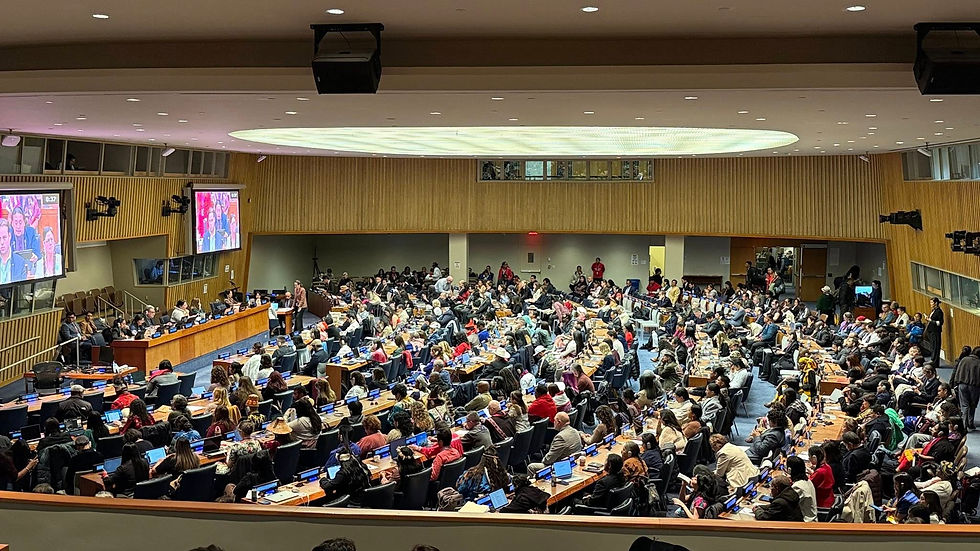
Gathered in Belém, Brazil, at the mouth of the Amazon, the two weeks unfolded against the backdrop of the world’s largest rainforest and the frontline communities who defend it. We witnessed powerful Indigenous-led mobilizations, relentless civil society advocacy, urgent demands to phase out fossil fuels and keep 1.5°C within reach, climate-charged downpours flooding the venue, and a fire that broke out in the COP30 pavilion area. All the while, governments engaged in fierce negotiations over how—and whether—they will move from promises to real implementation of the Paris Agreement.
Hosting COP30 in the Amazon was more than a logistical decision — it was a statement of justice. Holding the world’s largest climate summit in Belém aimed to force governments, corporations, and negotiators to confront the realities too often ignored in air-conditioned conference halls: the frontline of the climate crisis is not theoretical, it is lived. By convening COP30 in the Amazon, Brazil insisted that climate policy must be grounded in the experiences of the peoples and ecosystems most exploited by centuries of colonial extraction. It was a reminder that any path to a livable future must begin with those who have contributed the least to the crisis yet bear its heaviest burdens.

The Amazon is critical to the world not only for its biodiversity, carbon sequestration, and freshwater systems, but also because it embodies the interconnectedness of global justice. Its forests regulate rainfall across continents, and cradle one of the richest webs of life on Earth. When the Amazon is cut, burned, or poisoned, the climate consequences ricochet across the globe — drying fields, intensifying storms, destabilizing food systems, and endangering millions. But this is not just a story of ecological collapse; it is a story of power. Protecting the Amazon requires confronting the political and economic forces that profit from destruction while offloading the costs onto vulnerable communities and future generations.

At COP30, Indigenous leaders demanded that the world finally listen. Their message was clear that protecting the Amazon is not an act of charity — it is a matter of rights, sovereignty, and survival. Indigenous Peoples have safeguarded the forest for millennia, not through profit-driven management plans but through relationships of reciprocity, responsibility, and deep ecological knowledge. They are calling out false solutions that continue to commodify their lands, and they are insisting that real climate action means securing Indigenous land rights, ending extractive violence, and centering Indigenous governance in global climate policy. Their leadership exposes a truth the world can no longer ignore that the Amazon does not need saving from its inhabitants, it needs protection from the systems that have treated it as a sacrifice zone.
The need for robust climate action has become even clearer in the wake of landmark rulings from the Inter-American Court of Human Rights (IACHR) and the International Court of Justice (ICJ). Both advisory opinions affirmed that, to meet their human rights responsibilities, states must act with the highest ambition possible to achieve the goals of the Paris Agreement. Notably, the ICJ ruled that fossil fuel production, expansion, and subsidies are illegal under international law, and states that fail to reduce emissions and transition away from fossil fuels may be required to pay reparations.
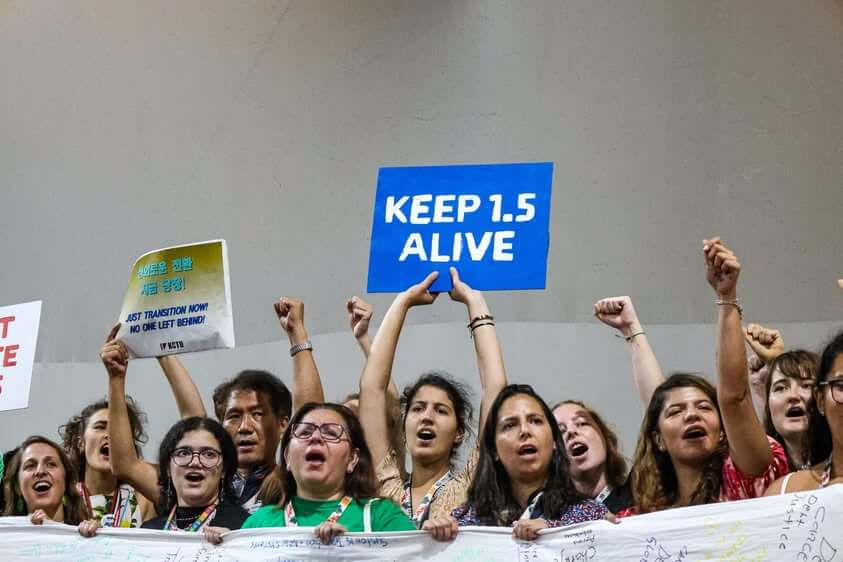
The science is clear, the pathway is drastically narrowing to keep global warming below 1.5°C from preindustrial levels. Global greenhouse gas emissions reached a record 57.7 billion metric tons carbon dioxide equivalent in 2024, a 2.3% increase compared to 2023 levels. The recent round of Nationally Determined Contributions (NDCs), which outline countries’ climate actions, falls vastly short of what is needed to mitigate the worst impacts of the climate crisis. 120 countries representing 74% of global emissions have now submitted their plans, which have “barely moved the needle” on climate action, according to the UNEP. Global warming projections from current NDCs are 2.3-2.5°C, a dangerous overshoot of what science calls for and the Paris Agreement goal. Wealthy countries, in particular, are failing to do their fair share to address the climate crisis. A CAN analysis shows that no developed countries are aligned with Paris under three criteria: ending fossil fuel production, delivering public climate finance, and ensuring a just and equitable transition. NDCs from the US, UK, Canada, Brazil, and Japan would take up 36% of the post-2030 carbon budget for 1.5°C. Within this context, the goal of keeping 1.5°C alive and pushing governments for more ambitious climate action was a central demand for both the COP Presidency and civil society.
The United States, the largest historical emitter, was notably absent from COP30, with the Trump Administration having exited the Paris Agreement earlier this year and confirming that no high-level representatives attended COP30 in Belém. The US media also lacked a meaningful presence, with none of the big four broadcasters – CBS, NBC, ABC, and Fox – sending teams to COP30. With the exception of some outlets, including the New York Times, Associated Press, and Democracy Now!, US journalists were largely absent, leaving a clear reporting void. Although the US was not physically at the table in Belém, it still exercised influence over climate decision-making. Ahead of COP, the Trump Administration was accused of using “bullying tactics” to kill a multilateral deal to reduce emissions from cargo ships. These combative strategies, combined with the aggressive fossil fuel expansion agenda in the US, created a noticeable chilling effect at COP30, many reported. Additionally, US fossil fuel companies were in attendance at COP30, including Texas-based ExxonMobil. Recent reporting reveals documentation of Exxon funding think tanks to spread climate misinformation throughout Latin America.
TOP LINE SUMMARY OF COP30 OUTCOMES:

On November 22, governments finalized the outcomes of the 2025 United Nations Climate Change Conference—COP30.
The wins:
In the Just Transition Work Program, Parties adopted a hard-fought-for Just Transition mechanism, which mandates the coordination and enhancement of international cooperation for just transition pathways. The outcome text of the Just Transition Work Programme includes Indigenous rights, care and informal work, human rights, and grant-based finance. This win was fought by and for civil society movements, in alliance with specific countries—particularly the G77+China group— that worked steadfastly for years to move the program from dialogues to implementation.
After a grueling two weeks, the 9-year Belém Gender Action Plan was approved, which includes essential language from the Women and Gender Constituency, including specific references to women environmental defenders, care, and gender- and age-disaggregated data.
In the closing plenary, the COP30 Presidency announced further work on roadmaps to transition away from fossil fuels and to stop deforestation. This was a significant announcement because both of these essential components were not in the formal outcomes.
In the closing plenary, the COP30 Presidency also highlighted the upcoming April 2026 Conference on Fossil Fuel phaseout, hosted by Colombia and the Netherlands. This is building a bridge between discussions inside the UNFCCC and countries working on a concrete plan outside of the UNFCCC to phase out fossil fuels based on science and equity.

The victories come from the people’s movements, in solidarity with aligned countries who have been pushing for action and justice within the UNFCCC. WECAN has been participating in the Women and Gender Constituency Just Transition Working Group for almost two years, and some eight years for the forward progress on the Gender Action Plan. We are elated to celebrate the newly adopted Just Transition mechanism and the Belém Gender Action Plan while recognizing the deep flaws that remain in the UNFCCC structure and the failures at this year’s COP30.

The failures:
There were over 1,600 fossil fuel lobbyists at COP30, and the impact was deeply felt. Across negotiations, language on the transition away from fossil fuels was heavily contested and—against the wishes of many countries and civil society—was excluded from all outcome documents. While more than 80 countries rallied for a concrete, binding plan to phase out fossil fuels within the UNFCCC process, fossil fuels were not part of the COP30 outcomes. Parties have a mandate from the COP28 UAE Consensus and a legal obligation from the recent ICJ Advisory Opinion on Climate Change to transition away from fossil fuels, but continue to stall forward progress.
Wealthy Global North countries continue to block and reduce their commitments to much-needed climate finance for adaptation, and most other agenda items. The Global South is owed climate reparations due to wealthy countries' outsized and historical contribution to the climate crisis. Further, there is no implementing the Paris Agreement or furthering ambition without climate finance.
Heralded as the “Indigenous COP”, Indigenous Peoples from across the Amazon called out the colonial practices of the UNFCCC, which denied many leaders access to the Blue Zone where decisions were being made about their territories and communities. In response to Indigenous led actions, the UNFCCC called for increased military presence to quell Indigenous Peoples’ advocacy. While there were successes in the inclusion of Indigenous rights in the Just Transition Work Programme, parties excluded text on the impacts of so-called critical minerals, which already are leading to Indigenous rights violations and environmental degradation. Further, in the Global Mutirão cover text, Indigenous Peoples were not included in the operational section. Indigenous rights are a climate solution and must be at the core of climate policy and programs, especially when they impact the territories and lives of Indigenous communities globally.
The COP process has continued to allow bad actors to block good progress. We need reform of the UNFCCC process to keep fossil fuel lobbyists out, increase Indigenous, civil society, and stakeholder engagement, and ensure transparency throughout the negotiations. Ultimately, we cannot achieve global climate action without multilateralism, and after 30 years, we know the UNFCCC must really consider what is needed to mobilize and implement the empty and growing pledges and promises from years past.
The urgent work ahead:
While WECAN is excited about the Just Transition mechanism, the overall outcomes from COP30 do not deliver action on the urgency of the climate crisis. In the next year, WECAN will continue robust advocacy to hold governments accountable and to push the COP presidency to uphold its commitment to halting deforestation and phasing out fossil fuels.
Without guaranteed funding and the political courage required to put commitments into practice, the progress made remains uncertain. Moving ahead, real resources need to be on the table, rights need to be secured, and a Just Transition needs to be defined by the leadership of frontline communities who are already taking action. WECAN will be working toward these efforts.
Serving on the Fossil Fuel Non-Proliferation Treaty Steering Committee, WECAN will be supporting and engaging in the conference on fossil fuel phaseout hosted by Colombia and the Netherlands.
We know that what has been delivered at COP30 is profoundly insufficient. It falls short for the millions of people already living through climate-fueled disasters. It falls short for the forests, waters, and ecosystems being irreversibly damaged by fossil fuel expansion, deforestation, and accelerating climate chaos. It falls short for the generations who will inherit a world shaped by decisions made today— decisions that should honor their right to a livable, just, and thriving planet.
In the final COP30 plenary, there was exhaustion and tension when Colombia courageously halted the proceedings, refusing to rubber-stamp yet another weak mitigation package that does not address the root of the crisis: fossil fuels. Delegates had pushed hour after hour toward an outcome that spoke in vague promises and evasive language, but Colombia stood up and said what frontline communities and climate-vulnerable peoples have been shouting for decades: there can be no real climate action without an explicit, equitable, and time-bound phase-out of coal, oil, and gas.
“According to the IPCC, nearly 75% of global CO2 emissions come from fossil fuels. There is no mitigation if we cannot discuss transitioning away from fossil fuels with means of implementation in a just and orderly way.” — Daniela Durán González, Head of International Affairs at the Colombian Ministry of Environment and Sustainable Development, Colombia Delegation
WECAN was in the plenary when the objection was made by Daniela Durán González, Head of International Affairs at the Colombian Ministry of Environment and Sustainable Development, and the hall erupted into cheers and massive applause. Find a recording of her statement here:
The objection from Colombia, along with others from Latin America, forced the COP30 President to call an unplanned recess and halt the closing plenary. While unfortunately, the mitigation text was already gavelled through, meaning that it could not be reopened for further discussion, the objection exposed the deep injustice at the heart of these negotiations: powerful nations protect fossil fuel interests while those least responsible for the crisis bear the heaviest losses. In that moment, Colombia disrupted not just the plenary but the illusion that incrementalism is enough, insisting that climate justice means naming the problem and committing—finally—to end it.
Our deepest hope is rooted not in the halls of negotiation but in the power of people’s movements and aligned countries across the world. Communities are rising with clarity and courage, demanding the future we deserve, advancing real solutions grounded in Indigenous knowledge, feminist principles, and frontline leadership, and insisting on a world shaped by care, consent, justice, and liberation.
Please continue on in our report back for further analysis of key takeaways from various negotiating tracks, as well as further information about WECAN’s advocacy and events both inside and outside of the UNFCCC.
INDIGENOUS PEOPLES AT THE CENTER OF COP30
“[The] UN is supposed to be a safe space for us to echo our voices. We, as Indigenous Peoples, want to have the right to sit at the table as our own governments, traditional leaders, because we have the solution for climate action. We don't want to do this by ourselves. We want to do this [collectively] and I think the power of women is in that.” — Taily Terena (Terena Nation), Pantanal, Brazil, WECAN COP30 Delegate

For the past two years, Indigenous Peoples have been organizing for COP30 in the Amazon. This year’s Conference marked the first time a COP was hosted in the Amazon region, and the presence of Indigenous Peoples was felt every single day through their advocacy and work to ensure that their demands were heard during COP30.
During the first week of COP30, dozens of Indigenous activists breached security barriers to occupy the Blue Zone, drawing global attention to governments’ continued failure to meaningfully address the escalating climate crisis and the persistent lack of adequate Indigenous representation within the negotiations. Their action was a direct response to years of exclusion and tokenization within UN climate processes. This protest made visible a truth long known yet routinely ignored in global climate governance: Indigenous Peoples are among the most effective protectors of forests, water systems, and biodiversity, and their leadership is indispensable for any realistic path toward climate stability. Despite stewarding the world’s remaining biodiversity and protecting some of the most carbon-rich landscapes on Earth, they continue to be marginalized in the very forums tasked with shaping global climate solutions.
While Indigenous delegates are often invited to offer cultural performances, opening prayers, or statements on the margins, their demands for land rights, Free Prior and Informed Consent (FPIC), and direct decision-making power in climate policy often remain sidelined. This is particularly alarming because Indigenous land-management practices have been proven to reduce deforestation, safeguard watersheds, and maintain ecological balance, offering strategies that far outperform many top-down conservation or carbon-market schemes promoted at the COPs.
On November 14, Representatives of the Munduruku People, organized by the Ipereg Ayu Movement, blocked the main entrance to the COP30 Blue Zone to demand an urgent meeting with President Luiz Inácio Lula da Silva, implementation of the right to FPIC, and the denouncement of federal projects that harm Indigenous communities and the environment. In a statement, the Munduruku Ipereg Ayu Movement, also opposed market-based mechanisms including carbon credit projects, and REDD+, which studies have shown do little to stop the climate crisis or cut emissions at the source, while not benefiting Indigenous communities or respecting Indigenous rights, forest knowledge, or practices.
Following the action, Munduruku leaders met with COP30 President, Andre Corrêa do Lago, COP30 Executive Director Ana Toni, and Ministers Sônia Guajajara and Marina Silva of the Indigenous Peoples and Environment and Climate Change ministries, respectively.
The protests highlighted how Indigenous Peoples are among the most impacted by deforestation, extractive industries, carbon offset projects, and climate-induced displacement, and yet still remain structurally marginalized within global climate negotiations. At COP30, held in the Amazon—a region whose survival depends on Indigenous guardianship—this contradiction felt especially stark. Many Indigenous participants noted that although the Brazilian government celebrated the symbolism of hosting the summit in Belém, this did not translate into meaningful shifts within negotiation rooms, where discussions about carbon markets, forest governance, and loss and damage finance remained dominated by Global North governments and corporate lobbyists. Meanwhile, Indigenous communities continue to protect the forests and rivers that stabilize the world’s climate, often without recognition or adequate support.

In response to the peaceful actions outside of the Blue Zone, the UNFCCC Executive Secretary called for an increase in security forces at the COP30 venue and for the dispersal of protesters. This move was widely criticized as reinforcing long-standing patterns of criminalizing Indigenous resistance and escalating repression against civil society. For many observers, it symbolized the broader failure of the UNFCCC to create a safe, rights-affirming environment for Indigenous Peoples and other frontline communities who are fighting for survival—and for the ecosystems they safeguard—in the face of worsening climate impacts. Punitive security responses contradict the UNFCCC’s own acknowledgment that Indigenous knowledge is essential for ecosystem protection, climate adaptation, and community resilience.
WECAN, alongside more than 200 human rights and environmental organizations, joined an open letter spearheaded by the Human Rights & Climate Change Working Group, condemning the call for heightened security. The letter stressed that such actions create “a chilling effect and a feeling of unsafety for Indigenous peoples, environmental and other human rights defenders, civil society, and activists standing up for their rights.” The signatories emphasized that climate justice cannot be achieved in a space where those most affected feel surveilled, silenced, or intimidated for speaking truth to power—especially when they are the same peoples who successfully defend forests, maintain water integrity, and uphold the ecological knowledge that scientists increasingly recognize as vital for climate mitigation and adaptation.
Indigenous Rights and Engagement at COP30
Within the UNFCCC, Indigenous Peoples’ continue to advocate for their rights, sovereignty, and territories to be respected, protected, and central to climate solutions. During COP30, the Brazilian government announced the demarcation of 10 Indigenous territories, a vital step toward sovereignty. This process grants territories institutional recognition, affording them legal protections and is a prerequisite for receiving a formal land title. According to one study, expanding demarcated land could prevent up to 20% of additional deforestation and reduce carbon emissions by 26% by 2030.

The Indigenous Village near the COP30 venue in Belem— the Aldeia COP— hosted an unprecedented gathering of around 3,000 Indigenous Peoples. Built on the Federal University of Pará campus, the Village provided lodging, cultural stages, debate areas, and a spiritual house for traditional healing, becoming a hub where leaders demanded stronger forest protections, territorial demarcation as a core climate policy, and direct funding for community-led climate solutions.
Both inside and outside the COP venue, Indigenous delegations arrived with unprecedented organization and visibility. Side events, press conferences, and grassroots assemblies showcased powerful solutions rooted in traditional ecological knowledge, land stewardship, and community-based models for protecting biodiversity. These gatherings made clear that Indigenous Peoples are not victims at the margins but leaders offering some of the most effective, time-tested strategies for protecting forests, water sources, and whole living systems. Some national delegations, particularly from Latin America and the Pacific, included Indigenous representatives within official negotiating teams—an important step toward meaningful inclusion.
While COP30 saw a record number of over 900 Indigenous delegates in the Blue Zone, where the formal negotiations take place, the final outcomes do not reflect the powerful showing of leadership from Indigenous communities both inside and outside the COP venue. Finance for Indigenous communities was hardly mentioned, and strong commitments to respect Indigenous knowledge and leadership were sparsely included in the negotiated text or the UNFCCC process.

However, Indigenous Peoples successfully secured strong rights-based language in the Just Transition Work Programme (JTWP). The paragraph on Indigenous rights, is one of the strongest we have ever seen in the UNFCCC:
“The importance of the rights of Indigenous Peoples and of obtaining their free, prior and informed consent in accordance with the United Nations Declaration on the Rights of Indigenous Peoples, and the importance of ensuring that all just transition pathways respect and promote the internationally recognized collective and individual rights of Indigenous Peoples, including the rights to self-determination, and acknowledge the rights and protections for Indigenous Peoples in voluntary isolation and initial contact, in accordance with relevant international human rights instruments and principles” (Paragraph 12 (i))
Unfortunately, the JTWP (see next section for more analysis), fell short in naming the social and environmental risks associated with transition mineral mining and extraction, a critical demand from Indigenous Peoples and civil society. According to a 2022 study, over half of mining projects for transition minerals are located on or near Indigenous territories. The Transition Minerals Tracker illustrates how these projects are also violating Indigenous and human rights, and targeting environmental and land defenders. We are witnessing the same process of harms and violations from mineral mining as we’ve witnessed for decades from fossil fuel extraction projects. For a Just Transition, Indigenous rights, specifically the right to Free, Prior, and Informed Consent (FPIC), cannot be left out of the decision making process, and must be placed at the center of dialogues around implementation, action, and accountability. Indigenous peoples are the best stewards of their territories and lands, and their rights must be upheld and respected as they work to protect global biodiversity and our global climate. Although transition minerals were named in an earlier draft of the JTWP text, it was ultimately removed from the final document.
At COP30, WECAN released a report, Indigenous Rights are Vital to a Healthy and Just World, which outlined recommendations to governments and the UNFCCC to respect Indigenous rights, especially the right to FPIC. It emphasizes the vital role of Indigenous Peoples, especially Indigenous women, as leaders in successful climate solutions.
While there was strong language on Indigenous rights in the JTWP, in the Global Mutirão, Indigenous Peoples were not included in the operational section of the text.
Indigenous leaders are risking their lives to protect and defend their territories from extraction and environmental degradation. During COP30, on Sunday, November 16, Vicente Fernandes Vilhalva, a Guarani Kaiowá leader, was murdered during a land reclamation effort. The violence against Indigenous Peoples continues to proliferate. Within and beyond the UNFCCC it is imperative to ensure protections and safeguards for environmental and land defenders who risk their lives to stop extractive projects and protect their territories, communities, and our planet.
As part of WECAN’s ongoing efforts to support women land defenders, we released the “Escazú Agreement Toolkit for Women Land Defenders and Frontline Communities,” which details specific guidance on domestic laws to help women land defenders achieve protections under the Escazú Agreement. The Escazú Agreement is a historic treaty in Latin America and the Caribbean, with one element of the Agreement that aims to uphold the rights of women land defenders. More details about the Escazu Agreement are included further along in this report.
“Parties, there is NO true multilateralism without the real inclusion of Indigenous Peoples. Our duty to our future generations requires us to put relationships over ego, money, and power. It’s time for you to learn to do the same.” — Closing statement from the Indigenous Peoples’ Constituency, delivered by Diana Chavez Vargas of Ecuador
The events at COP30 reignited urgent calls for reforms to the UNFCCC system, including guaranteed seats for Indigenous Peoples in negotiations, stronger rights-based safeguards across all climate mechanisms, and formal protections for activists within COP spaces. Climate justice cannot be achieved without fully recognizing Indigenous sovereignty, securing land and water rights, ensuring safety for defenders, and elevating Indigenous leadership at every step of climate decision-making. Their presence at COP30 demonstrated resilience, unity, and a continued insistence that real solutions come from the peoples whose knowledge systems, land stewardship practices, and relational responsibilities have successfully protected Earth’s forests, waters, and biodiversity for millennia.

Just Transition Victory at COP30

One of the most significant victories of COP30 was progress in the Just Transition Work Programme (JTWP). Parties have agreed to develop a Just Transition mechanism to coordinate and enhance international cooperation for implementing Just Transition pathways. This is a critical step for moving beyond dialogues towards action, and represents a significant part of WECAN’s advocacy efforts at the formal negotiations.
The JTWP was established in 2022 at COP27 to guide countries in Just Transition pathways to achieve the goals of the Paris Agreement. At COP29, negotiations on the JTWP collapsed, and Rule 16 was applied to the JTWP, resulting in the draft text being totally thrown out and Parties having to start anew in 2025. Collective efforts to ensure a successful outcome at COP30 have been underway all year.
Ahead of the 62nd Sessions of the UNFCCC Subsidiary Bodies in Bonn in June 2025, the Women and Gender Constituency, aligned constituencies, and members of civil society strongly increased the pressure on Just Transition. The JTWP is only a 3 year program, a short window that necessitated a move from dialogues to implementation. Leading up to COP30, civil society released the call for the Belém Action Mechanism (BAM), an actionable framework under the UNFCCC that would support coordination and coherence among Parties to implement their Just Transition pathways. Outlined by civil society, the BAM would serve as an enabler, providing critical assistance to facilitate international cooperation, share best practices, methodologies, and tools, and ensure diverse representation from all stakeholders. It is founded on the principle of Common But Differentiated Responsibilities and Respective Capacities (CBDR-RC), which means that all States have a shared responsibility to address the climate crisis, but individual levels of responsibility correlate to their historical emissions contributions.
From the onset of negotiations, Parties were split on support for the BAM, with a counter-proposal from the European Union emerging for a Just Transition Action Plan (JTAP). The JTAP was proposed as a set of activities and guidance under the JTWP, while the BAM would be a new institutional arrangement to catalyze the work program into action. WECAN, as part of the WGC and alongside other civil society groups, advocated fiercely for the adoption of the BAM at COP30 as an essential tool for the Just Transition.
We collectively warned of the fall backs of an Action Plan (learned from the past 5 years with the Gender Action Plan), noting that Action Plans must live under a specific program with certain outlined modalities. Given that the current modality for the JTWP is only to carry out dialogues, an Action Plan would be less appropriate. Conversely, a mechanism would be a new institutional arrangement with specific functions, moving the JTWP from dialogues to implementation.
While the text does not explicitly use the title of the BAM, Parties agreed to move forward with developing a Just Transition mechanism, and will present a draft decision on the process of operationalization at the SBs in June 2026, to then bring for consideration at COP31.

Alongside the fight for the Just Transition mechanism, countries also discussed the Just Transition principles, which are outlined in paragraph 12 of the final text. These principles are the outcomes of dialogues that have been taking place since COP28, and as part of the WGC, WECAN advocated for the inclusion of care work, gender equity, Indigenous and human rights, fossil fuel phaseout, and references to critical minerals and environmental impacts. Sadly, the backlash against gender just language that surfaced in the negotiations surrounding the Gender Action Plan (see below), leaked over to the Just Transition negotiations, where some Parties were calling for gender to be redefined as biological sex or to be removed entirely.
Included in the final text is explicit language on Indigenous rights, including the right to Free, Prior, and Informed Consent; care economy and informal workers; rights-based language; and references to grant-based, highly concessional finance and non-debt instruments. There is also a specific reference to “Mother Earth” in the text. Again, these inclusions demonstrate the powerful advocacy that took place across constituencies.
While WECAN advocated for references to finance, transitioning away from fossil fuels, and naming the harms of transition mineral mining, these were not included in the final text. The goal of the Just Transition is explicitly to move away from the current economy that is founded in fossil fuel extraction. Any progress on the Just Transition is impossible without naming the core industry that society is transitioning away from. Further, many of the harms perpetrated by the fossil fuel industry are now being perpetuated by mining projects for transition minerals. The shift to renewable energy systems has led to an increased demand for transition minerals such as lithium, cobalt, and nickel, which are used in technologies like batteries and solar panels. However, the extraction of these minerals poses significant risks to communities, ecosystems, and human rights, particularly in the Global South.

Mining projects often displace Indigenous Peoples, degrade ecosystems, and exacerbate social inequalities, directly contradicting the goals of the JTWP. While there is an urgent need to reduce emissions, the transition must be carried out equitably. Safeguards in the JTWP are essential to ensure the very same systems of harm that drive the climate crisis are not replicated in a transition away from fossil fuels. Much of this work will not be implemented unless there is robust and just finance. This is a pitfall across the negotiations this year, and one WECAN continues to address throughout the year inside and outside the COP.
During COP30, Katherine Quaid (Confederated Tribes of Umatilla), WECAN Communications Director spoke at two events representing the demands of the WGC Just Transition working group and calls for integrating a praxis of care into a Just Transition.

This win in the JTWP is a clear example of what can happen when civil society, and supportive countries, specifically the G77+China group, come together to push for implementation and action. We are looking forward to continuing our engagement in the WGC Just Transition working group to hold Parties to account and support their efforts to develop the mechanism.
Ultimately, WECAN recognizes that the Just Transition is more expansive than what is outlined in the JTWP, and goes beyond decarbonizing the economy. It is about transitioning communities away from polluting and extractive activities and building renewed relationships that prioritize care, equity, reciprocity, and harmony with nature. This work is crucial in combating the climate crisis, as it addresses the root causes of social injustice and environmental degradation. It ensures that the transition away from fossil fuels upholds human rights and works within planetary bounds. Through WECAN’s Just Transition programming, we are not only advocating inside the UNFCCC, but are also engaged in Just Transition movements worldwide to advance climate justice solutions that uplift community well-being, ecological balance, and respect for human rights. See our website for more information about WECAN’s Just Transition program.
The Fossil Fuel Treaty Surges Despite Blocks on Fossil Fuel Phaseout in the UNFCCC

At COP30, climate justice advocates arrived in Belém with the clear mandate of the Global Stocktake (GST) decision at COP28, which for the first time named the need for governments to transition away from fossil fuels. But from the opening days of COP30, it was clear that oil-rich countries and the fossil fuel industry had no intention of letting that momentum carry forward. More than 1,600 fossil fuel lobbyists flooded the halls—outnumbering all national delegations other than Brazil’s—and their presence, along with many oil producing countries, shaped the tone, pace, and final content of the negotiations. In a tragic reversal, all language referencing fossil fuels was systematically stripped from the outcome documents, despite the adoption of the COP28 UAE Consensus and reinforced by the new International Court of Justice Advisory Opinion on Climate Change.
This betrayal of science and justice was felt most acutely by communities already living through deadly heat, collapsing ecosystems, and disappearing homelands. For them, the exclusion of fossil fuel phaseout language was not a diplomatic inconvenience; it was a direct assault on their right to survive. Eighty countries fought hard for a concrete and binding plan to phase out fossil fuels under the UNFCCC framework, repeatedly invoking equity and the principle of common but differentiated responsibilities. Yet the influence of Big Polluters proved overwhelming. Civil society and delegates calling for greater transparency in lobbying warned that the UN climate process cannot meaningfully protect people if it continues to welcome those actively destroying the planet. The calls to “Kick Big Polluters Out” were louder than ever, but still went unanswered.
The COP30 Presidency attempted to push more ambition by presenting a roadmap for accelerating the global transition away from fossil fuels, emphasizing the need for steep emissions cuts, technology transfer, and massively ramped-up finance for a just energy transition. But without binding commitments, and with fossil fuel phaseout language erased from the political decisions, the roadmap served more as a reminder of what could have been achieved than as a vehicle for real accountability. Civil society groups stressed that a voluntary pathway cannot meet the scale or the speed required to keep global heating below 1.5 °C. There is no habitable planet without an urgent and equitable phaseout of coal, oil, and gas.
In this vacuum of political bravery, the Fossil Fuel Non-Proliferation Treaty emerged at COP30 as a beacon of moral clarity. Although not part of the formal negotiations, the Treaty initiative had a visible, powerful presence across the venue, offering the kind of decisive action that Parties themselves refused to take. The movement’s call to end the expansion of fossil fuels, phase out existing production, and ensure a Just Transition for workers and communities resonated deeply with those frustrated by the paralysis of the UNFCCC process.

Momentum for the Treaty surged in Belém. Cambodia’s endorsement marked a significant milestone, demonstrating growing support from, now, 18 nations. Announcements were made about a global fossil fuel phaseout conference to be held in April 2026. The conference will take place in Santa Marta, Colombia, co-hosted by Colombia and the Netherlands. This is not a symbolic gathering, but explicitly framed as a “just transition” summit to build a concrete, science-aligned roadmap for phasing out coal, oil, and gas extraction.
Governments, civil society, Indigenous and Afro-descendant communities, labor unions, technical experts, and academics will convene to explore the legal, economic, and social dimensions of fossil fuel phaseout — from subsidy reform and trade impacts to job transitions, energy security, and renewable deployment. The conference is designed to be complementary to the UNFCCC, building on but going beyond COP negotiations. The gathering aims to institutionalize global cooperation around a managed, equitable phaseout — particularly for fossil-fuel-dependent countries — and feed into the broader campaign for a Fossil Fuel Non-Proliferation Treaty.
The presence of the Treaty at COP30 did not go unnoticed by the presidency. In a moment that elated advocates, the COP30 Presidency publicly acknowledged the Treaty and the upcoming conference during the final COP30 plenary. The shout-out signaled that the Treaty is increasingly seen as complimentary to the Paris Agreement, and a necessary architecture for managing a fast, fair, funded, and globally coordinated phaseout.
WECAN Executive Director, Osprey Orielle Lake, sits on the steering committee for the Treaty, and WECAN supported efforts to highlight the Treaty throughout COP. COP30 showed that fossil fuel interests still wield enormous power, but it also revealed a rising, organized, and justice-centered movement that is no longer waiting for permission to demand the end of the fossil fuel age.
Governments Adopt the Belém Gender Action Plan

The Belém Gender Action Plan (GAP) was adopted at COP30 after two weeks of intense advocacy by Parties and civil society groups. This achievement is vital as it aims to ensure gender-responsive, transformative policies are embedded throughout climate action across the UNFCCC. As a member of the Women and Gender Constituency (WGC), WECAN advocated for a robust Belém GAP to strengthen the coherence of gender equity and women’s leadership in climate action. The final text approved at the end of COP30 reflects both wins and losses for gender equity that will guide climate action through 2034. Despite strong advocacy coordinated by the WGC, the Belém GAP ultimately lacks a meaningfully intersectional framework, with “gender-diverse people” and LGBTQ+ rights-based language removed from the text. The Belém GAP also does not have any direct source of funding, which risks leaving the work program without any means of implementation.
Despite these insufficiencies in the Belém GAP text, many hardfought wins were adopted. The text establishes five priority areas for activities and objectives: capacity-building, knowledge management and communication; gender balance, participation, and women's leadership; coherence; gender-responsive implementation and means of implementation; and monitoring and reporting. Feminist advocates successfully held the line against backlash on women’s rights during negotiations as arguments over the definition of “gender” and disagreements on key terminology diverted progress away from the vital objectives of the Belém GAP. Attempts by multiple Parties to redefine “gender” in footnotes, often equating it to biological sex, were eventually removed from the text due to strong advocacy from civil society and some Parties. Despite arguments over key issues, concepts like care, gender and age disaggregated data, violence against women and girls, women environmental defenders, and health were successfully integrated into text.
Women and girls of African descent were explicitly recognized, the result of successful advocacy from civil society groups across Latin American and the Caribbean. The inclusion in the Belém GAP was one win of a broader campaign to ensure Afro-Descendant peoples are recognized as a formal constituency within the UNFCCC. This campaign gained momentum this year, especially as Brazil is home to the largest population of people of African descent outside of the African continent, with Black and mixed-race people representing 55.5% of the population.
The Belém GAP adopted at COP30 is the result of years of collective feminist advocacy, and holds immense potential to advance gender equity and the full, equal, and meaningful participation of women and gender-diverse people throughout climate action. Moving forward, the Belém GAP must be effectively implemented and guide UNFCCC actions.
Climate Finance Obstructed Again

At COP29 in Baku, Parties failed to adopt a justice-based approach to climate finance by gaveling through a contentious $300 billion New Collective Quantified Goal (NCQG) on Climate Finance. This NCQG fell vastly short of the demands from climate-vulnerable countries, economic analysts, civil society groups, and frontline communities, who continue to call for at least $5 trillion in annual climate finance from the countries most responsible for the climate crisis. Wealthy, industrialized countries, largely situated in the Global North, are historically responsible for the majority of greenhouse gas emissions and fossil fuel production. Just 23 countries are responsible for half of all historical emissions and five countries (the UK, the US, Canada, Norway, and Australia) are responsible for over two-thirds of new oil and gas licenses issued globally since 2020. Under Article 9.1 of the Paris Agreement, these wealthy countries have an obligation to provide financial resources to help low-income countries meet their adaptation and mitigation goals. However, the NCQG failed to adequately address this amidst strong pushback from wealthy countries. In addition to the insufficient quantum, the NCQG did not meet demands to ensure an adequate quality of climate finance.
The inadequate NCQG goal has created conflict in negotiations since its adoption last year, as all climate action under the UNFCCC is dependent on funding. Ahead of COP30, a push for Article 9.1 to be a standalone agenda item stalled discussions at the 62nd sessions of the Subsidiary Bodies in June 2025 for two days. To avoid a similar outcome at COP30, Article 9.1, in addition to three other contested issues, was left off the formal agenda and held instead as Presidency consultations throughout the Conference. The outcome of these consultations was insufficient: establishing a two-year work program on climate finance, including on Article 9.1. The text notes that this will not “prejudge” the “process on the implementation of the new collective quantified goal.” This is wholly unresponsive to the urgent need for wealthy countries to pay their fair share of climate finance. According to a 2025 Oil Change International report, wealthy countries have the means to mobilize well over $6 trillion in public climate finance. The Global Mutirão committed only to creating new dialogues around the NCQG without any meaningful interrogation of insufficient and inequitable climate finance flows.
On adaptation, COP30 provided only vague promises to triple adaptation finance by 2035. Without clarity on the goal’s starting point, type of finance, and responsible party, this commitment fails to deliver any meaningful progress on climate finance. While gender was included in the indicators for the Global Goal on Adaptation agreed upon at COP30, these remain too vague and immeasurable to drive sufficient progress, and were contested by several Parties in the closing plenary.

At COP30, WECAN released a policy brief, Justice-Based Climate Finance for COP30 and Beyond, which outlined concrete recommendations for governments to align climate finance with climate justice principles. This includes: funding the climate leadership of women and Indigenous Peoples; integrating the care economy into climate finance; redirecting funds away from climate destruction and false solutions; and financing community-led solutions and a Just Transition.
To truly advance climate justice, finance must be in the form of grants and reparation funds as a down payment for climate damages caused by carbon-intensive economies in the Global North. Loans and other investments increase the debt burden of low-income countries and should not be counted toward climate finance goals.
Looking ahead, climate finance must be a central aspect of all agenda items, as we continue to push to hold wealthy countries accountable for their role in ensuring we achieve the mandates of the Paris Climate Agreement. A second year of failure in climate finance is a failure for the millions of communities across the globe who need financing to adapt to and mitigate the climate crisis while addressing loss and damage and Just Transition pathways.
Despite clear demands from climate-vulnerable countries and civil society for justice-based climate finance, false solutions to the climate crisis were present in Belém, largely in the form of market-based mechanisms. These false solutions do not stop emissions at the source, often enable fossil fuel proliferation, and attempt to commodify nature’s vital processes.
One of the most prominent market-based mechanisms promoted at COP30 was the Tropical Forest Forever Facility (TFFF), a fund led by Brazil that aims to provide financing for tropical forest protection. Rather than viewing forest ecosystems holistically as interconnected entities, the TFFF commodifies their components and prices one hectare of rainforest at $4. This value was not calculated based on ecological considerations, but rather on what price can deliver a financial return on the market. At the end of COP30, commitments to the TFFF reached $6.6 billion, falling short of Brazil’s $25 billion funding target. The TFFF, like many other market-based mechanisms, relies on extractive economic systems, presents significant risks to human and Indigenous rights, and fails to meaningfully uphold ecological integrity. To bolster real solutions to the climate crisis, governments, corporations, and financial institutions must move away from market-based schemes and instead prioritize frameworks that lead to equitable and effective outcomes. Please see WECAN’s initial analysis of the TFFF here. We will be releasing a report in 2026 with a thorough review of the TFFF.
Additionally for more analysis on false solutions, please read WECAN's policy brief, The Need for Real Zero Not Net Zero: Shifting from False Solutions to Real Solutions and a Just Transition.
Rights of Nature at the Forefront of COP30 as Movements Demand Systemic Change

The Rights of Nature movement made one of its strongest global showings to date at COP30, presenting a simple but radical truth: the climate crisis cannot be solved while the Earth remains treated as property. From the Amazonian streets to official UN negotiation halls, climate justice advocates insisted that recognizing nature as a rights-bearing entity is not a fringe idea, but a foundational shift needed to secure a livable future.
WECAN serves on the Executive Committee for the Global Alliance for the Rights of Nature (GARN) that led much of the movement’s coordination, arriving in Belém with a clear message that market-based climate solutions are failing, and the world must adopt legal frameworks that protect ecosystems for their own sake. GARN organized a Pre-COP30 Rights of Nature Summit, which drew Indigenous leaders, legal experts, organizers, and frontline communities to strategize around a rights-based ecological governance model rooted in reciprocity, care, and ancestral knowledge.
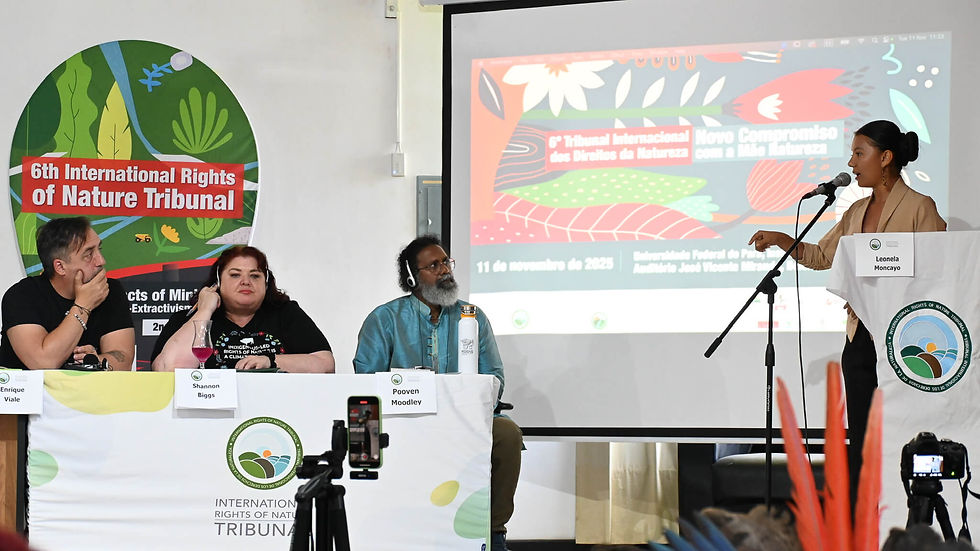
A major focal point was the 6th International Rights of Nature Tribunal, which held its final session on November 11 at the Federal University of Pará in Belém under the banner “A New Pledge for Mother Nature.” After earlier hearings on fossil fuels in New York and mining in Toronto, the Belém session brought testimonies from Amazonian communities, youth, scientists, and defenders whose lives and territories are threatened by deforestation, oil extraction, industrial agriculture, and state violence. Tribunal judges issued sweeping recommendations—including recognition of the Amazon as a rights-bearing entity, an end to fossil fuel expansion across the region, reparations for ecological colonialism, and protection of environmental defenders.
Casey Camp-Horinek (Ponca Nation), WECAN COP30 Delegate and WECAN Board Member, Patricia Gualinga (Kichwa), WECAN COP30 Delegate and Program Coordinator in Ecuador, and Osprey Orielle Lake, WECAN Executive Director, served as Tribunal judges. The judges’ conclusion was unequivocal, “The climate crisis is not a technological problem; it is a crisis of relationship.”
During the Rights of Nature activities at COP30, Indigenous leadership was unmistakably central. GARN’s Indigenous Council played a guiding role in shaping messaging and political demands, emphasizing that the Amazon cannot be protected without Indigenous sovereignty and stewardship. The Council’s members—representing diverse nations across the Amazon, the Andes, New Zealand, North America, and beyond—highlighted that any climate policy not grounded in Indigenous worldviews will replicate the same extractive patterns driving planetary breakdown.
Adding force to the Rights of Nature agenda, WECAN released a policy brief positioning Rights of Nature as a cornerstone of a truly Just Transition. The report argues that simply swapping fossil fuels for renewables without transforming the economic system will reproduce land grabs, mining booms, and violence against women and Indigenous peoples. Citing victories such as the recognition of the Marañón River’s rights in Peru, the WECAN policy brief frames Rights of Nature as an urgently needed pathway toward a healthy and just world for all.

At COP30, WECAN and GARN spotlighted the movement’s extraordinary momentum: 39 countries now have some form of Rights of Nature recognition, from local ordinances to constitutional protections. These laws have led to many victories—halting destructive projects, restoring ecosystems, and shifting legal precedent toward ecological personhood. For climate justice advocates, this global growth proves that Rights of Nature is not an abstract legal theory but a rapidly maturing field reshaping environmental law.
In Action for Rights of Nature at COP30
Throughout COP30, WECAN hosted multiple events inside the UNFCCC venue focused on the Rights of Nature movement and how it can offer a systemic framework for defending biodiversity, communities, and our climate. To learn more about the Rights of Nature activities and events that took place inside and outside of COP30, please see the section below titled "Speaking Out for Climate Justice: WECAN Events, Press Conferences and Collective Actions."
On November 12, WECAN co-hosted a pavilion event with GARN and ThinkFilm Impact Production at the Resilience Hub, “Rights of Nature: Rewriting Climate Action through Ecosystem Resilience, Equity, and Regeneration.” The event featured expert leaders representing communities around the globe who have implemented Rights of Nature frameworks successfully for their communities as a legal solution that creates a new path forward away from the current systems that continue cycles of exploitation.
“Breaking out of the human-centered limitations of the current legal systems is actually one of the most transformative actions humanity can take to create a healthy and just future. The crisis we are facing is not ecological, it's a direct result of patriarchy, colonization, racism, and capitalism, which are systems built on exploitation.” — Osprey Orielle Lake, WECAN Executive Director and Executive Committee Member of GARN

On November 18, WECAN hosted the “Rights of Nature: A Systemic Solution to the Climate Crisis” Press Conference where WECAN highlighted the work of the Rights of Nature movement, the recent Tribunal, and our report, “Rights of Nature as a Central Pillar of a Just Transition.”

On November 18, the GARN Indigenous Council also held an event at the Indigenous Peoples’ Pavilion to build pathways for centering Indigenous knowledge and leadership in global environmental governance, and highlight how Rights of Nature can support ongoing efforts for Indigenous sovereignty and climate action. During the event, members of the GARN Indigenous Council shared ongoing advocacy efforts to be in permanent compliance with the principles of reciprocity with Nature, which is part of the Indigenous cosmovision.

The climate crisis demands more than emissions targets. It requires a transformation of humanity’s relationship with the Earth. In Belém, where the Amazon’s vast rivers meet centuries of Indigenous resistance, the Rights of Nature movement made that vision impossible to ignore.
Women Led Forest Protection and Restoration as Effective Climate Solutions

Indispensable to the fight against the climate crisis is the protection of our global forests. Providing temperature and rainfall regulation, supporting biodiversity and livelihoods of Indigenous communities, and sequestering vast amounts of carbon, global forests are critical to all life on Earth and mitigating the climate crisis. Approximately, 1.6 billion people rely directly on forests for food, fresh water, clothing, traditional medicine, and shelter. The Amazon Rainforest, specifically, safeguards vast biodiversity of mammals, birds, insects, trees, and more, adding up to nearly one-third of the world’s recorded species – more than any other terrestrial ecosystem on Earth. Home to 40 million people, including 2.2 million Indigenous peoples of more than 300 ethnicities, as well as Afro-descendant Peoples, the Amazon provides an interconnected and complex system of species, ecosystems, and human culture – all reliant on a healthy and functioning Amazon Rainforest.
Leading scientists warn that the Amazon Rainforest is reaching its tipping point, which if hit, risks irreversible transformation from the largest tropical rainforest in the world to a dry savanna that would be more prone to fire and drought, and would release 200 to 250 bn tonnes of carbon dioxide warming the planet beyond the 1.5°C limit set by the Paris Agreement.
Despite these warnings, our global forests continue to be cleared at alarming rates due to mining, agribusiness, oil extraction, industrial expansion, and the overall commodification and devaluation of forests. Roughly 6.37 million hectares of forests worldwide were deforested in 2023 alone and climate disasters, including drought and fires, are intensifying the issue of forest loss. While extractive industries and governments continue to put forests at risk, studies are showing that Indigenous Peoples are the best stewards of forest landscapes– fighting against the current trends of deforestation. With Indigenous lands holding an estimated 54% of the world’s remaining intact forests, deforestation is found to be lower on Indigenous lands and they safeguard 40% of the world’s Key Biodiversity Areas (KBAs).
However, as forests face enduring threats, so too, do Indigenous Peoples. As deforestation and extractive projects increase, Indigenous lands are threatened with intensified fire and drought, Indigenous rights are violated from illegal logging, agribusiness, and landgrabbing, and Indigenous women land defenders are at higher risk of violence and attack. At COP30, WECAN brought a powerful delegation of women forest protectors to the negotiations, including leaders from the WECAN Women for Forests Program.

COP30 was nominally framed as a “COP of Implementation,” and indeed, nature — especially forests — was thrust to the center of the talks. Indigenous and forest-dependent communities at COP30 clashed with the realities of global power. During the large civil society march, banners like “Our forests are not for sale,” were abundant, yet COP30 failed to produce a binding agreement to halt deforestation by 2030. A forest-protection roadmap was stripped from an earlier draft of the Global Mutirão and the formal COP outcome was reduced to voluntary “coalitions of the willing,” not enforceable commitments. Although the COP President announced conducting his own roadmap process over the next year focused on halting deforestation in the closing plenary, the lack of formal commitments by governments was a failure from the COP. Global systems remain unwilling to tie forests to legal obligations, especially when big money is at play.
In terms of rights and land tenure, there was some positive progress: COP30 saw endorsements of the Intergovernmental Commitment on Land Tenure to protect tens of millions of hectares of Indigenous, Afro-descendant, and traditional community lands. This is potentially powerful, because secure land tenure is a cornerstone of climate justice — forest peoples must have control over their lands to steward them. But without a strong anti-extractive mandate, this commitment risks being overshadowed by finance-driven “solutions” that still prioritize the interests of investors over those of frontline communities. In short, COP30 delivered some symbolic recognition and funding, but reinforced the very system that treats forests as tradable assets rather than the ancestral homes and life-support systems of frontline communities.

The summit also saw the operationalization of the Tropical Forests Forever Facility (TFFF), a new mechanism created to pay for standing tropical forests. On the surface, this looks like a win: long-term finance, investment leverage, and acknowledgment that intact forests are more valuable than cleared ones. Yet from a climate-justice lens, the outcome is deeply troubling. The TFFF governance remains steeped in financialization: forest protection is treated as an “investment opportunity” rather than a matter of survival, rights, or justice.
WECAN released an initial critical review of the TFFF at COP30, presenting the drawbacks and potential harms. Please find WECAN’s analysis here for more details.
During COP30, WECAN robustly advocated for forest protection and restoration through our WECAN ‘Women for Forests' program, which aims to support a diverse constituency of international women as they rise up to protect and restore forests, and prevent and shut down extractive industries. The program includes strategic reforestation and supports long-term forest protection through advocacy for women land defender rights, forest monitoring, training sessions and workshops, uplifting women’s leadership, advocacy to stop deforestation by governments and corporations, and highlighting forest solution narratives. WECAN Women for Forests Program projects do not participate in any market-based mechanisms, including carbon offsets, carbon credits, biodiversity offsets, biodiversity credits, REDD+ schemes, and more. Learn more about WECAN’s Women for Forests Program.

At COP30, WECAN was honored to advocate, strategize, and present on panels and press conferences with WECAN Coordinators in the Brazilian and Ecuadorian Amazon, Lidia Guajajara (Guajajara), Indigenous Climate Activist and Communicator from Araribóia Indigenous Territory in the state of Maranhão and WECAN Guajajara Coordinator in Brazil, and Patricia Gualinga (Kichwa), Kichwa leader from Sarayaku, Ecuador, Spokeswoman for Mujeres Amazónicas Defensoras de la Selva (Amazon Women in Defense of the Jungle), WECAN Coordinator in Ecuadorian Amazon.
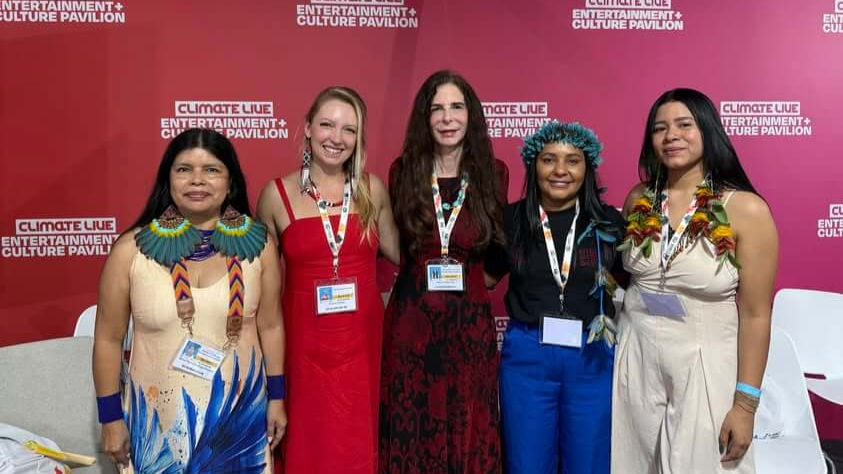
In the COP30 Blue Zone on November 18, WECAN co-hosted an inspiring and productive event with We Are Guardians, where frontline and Indigenous women leaders from the Amazon and International advocates showcased successful women-led solutions and strategies for reforesting and protecting ancestral territories. At the event, WECAN released our new video “Indigenous Women of Sarayaku Nurturing and Restoring the Ecuadorian Amazon Rainforest” which can be found here:
WECAN also attended the Afro and Indigenous Peoples Day at the If Not Us Then Who and Mídia Indígena village where Osprey Orielle Lake, WECAN Executive Director, spoke on the We Are Guardians Panel alongside partners Edivan Guajajara and Chelsea Greene, co-directors of the We Are Guardians film to highlight Indigenous leadership in forest protection. At this event, WECAN met with partners of the WECAN Reforestation and Forest protection project in Guajajara Territory, Brazil, Lídia Guajajara, WECAN Project Coordinator, and Edivan Guajajara, WECAN Guajajara Forest Advisor.

At the Aldeia COP30 (the Indigenous Village COP), the WECAN team met with Secretary Puyr Tembé, Nimuy Tembé, and Yara Tembé, who are the WECAN Tembé Project Coordinators in Brazil to discuss the WECAN Indigenous Women Restoring and Protecting the Brazilian Amazon: Tembé Territory project, and the challenges communities and territories are facing, such as drought, fires, violence from extractive industries, and intensifying climate disasters.
We also celebrated the launch of the ANMIGA Guardian Fund, which plans to drive initiatives led by Indigenous women for climate justice, transformation and well-being, to protect territories, life, and ancestry. We held many strategy meetings with ANMIGA, Célia Xakriabá, Federal Deputy for the state of Minas Gerais, and other partners in Brazil in support of collective work over the course of the last two years. We worked together to build power inside and outside the UNFCCC COP spaces, calling for Indigenous rights and land demarcation as a climate solution, long-term forest protection, women’s leadership and much more. This work included co-hosting, supporting, and engaging in many COP30 events and advocacy moments with partners in Brazil (please see below for more details).

Additionally, WECAN has been a longstanding advocate for the ratification and implementation of the Escazú Agreement as part of our Women for Forest program. Women land defenders in the Latin American and Caribbean region (LAC) must be free of threats and violence and their voices can be heard. Since 2018, WECAN’s Women for Escazú program has worked to collaborate with women land defenders across the LAC region, hosted on-the-ground and virtual educational events, and advocated within Escazú Agreement COPs to ensure women’s leadership and perspectives are centered in the Agreement’s implementation.
Adopted in 2018, the Escazú Agreement is a multilateral treaty across Latin America and the Caribbean and is the first legally binding agreement for environmental defenders. It guarantees access to information about the environment, participation in decision-making processes, and remedy for environmental harms. The Escazú Agreement holds immense potential to break the cycle of violence against land defenders, especially women, and provide safeguards for vital ecosystems. If implemented, it can enhance environmental justice, transparency, and remediation processes across the LAC. The LAC region is amongst the most dangerous in the world for environmental defenders, with advocates facing violent attacks, threats, illegal surveillance, sexual harassment, and criminalization. In 2024, 146 land and environmental defenders were murdered or disappeared for their work defending the right to a clean, healthy, and sustainable environment. Women–especially Indigenous women– face additional gender-based violence and discrimination rooted in patriarchal socioeconomic and political structures. Significant gaps in government reporting amplify the dangers of land defender work, as substantial underreporting makes crimes nearly impossible to remediate.
“Indigenous Peoples are the ones who defend the ecosystems our planet relies on for survival. That is why we, women land defenders, are raising our voices, to say no to extraction and harm, and to protect our territories for future generations. This is why we need the Escazú Agreement, to continue our work to protect our territories and Mother Earth.” – Patricia Gualinga (Kichwa), Spokeswoman for Mujeres Amazonicas Defensoras de la Selva, and WECAN Coordinator in the Ecuadorian Amazon
Since its adoption, 18 countries have ratified the Escazú Agreement. Leading up to COP30, Brazil’s Chamber of Deputies approved the ratification of the Agreement, which now awaits a vote in the Senate.

A central aim of WECAN’s Women for Escazú work is to ensure frontline women have access to the benefits of the Escazú Agreement. In partnership with the Vance Center, WECAN has produced legal toolkits for women land defenders and frontline communities to understand how the Escazú Agreement applies in their country. The “Escazú Agreement Toolkit for Women Land Defenders and Frontline Communities” provides guidance on domestic laws to help women land defenders achieve protections under the Escazú Agreement. Toolkits for Peru, Ecuador, Brazil, Bolivia, Colombia, and Antigua and Barbuda are available on WECAN’s website, which aim to advance the goals of the Escazú Agreement to ensure land defenders are free from censorship, threats, and violence. Accompanying these Toolkits, WECAN released legal reviews in 2021 for Antigua and Barbuda, Bolivia, Brazil, Colombia, Ecuador, and Peru. Additionally, country-specific analyses on Free, Prior, and Informed Consent (FPIC) are also available for Colombia, Bolivia, Brazil, Ecuador, and Peru.
At COP30, WECAN released five more Escazú Toolkits for Chile, Costa Rica, Guatemala, Mexico, and Panama. These will serve as vital resources for navigating legal complexities and ensuring that frontline defenders receive the full protections guaranteed by the Escazú Agreement. Women land defenders are the best advocates for our communities, Earth’s biodiversity, and the climate as a whole. Their message is clear: we need urgent, effective implementation of the Escazú Agreement.
WECAN Delivers Climate Justice Analysis, Policy Briefs, and Reports to COP30
Please see below a summary of the policy briefs, analyses, and reports WECAN released and delivered at COP30. Throughout the negotiations we distributed these materials with policy makers, negotiators, and partners.

The policy brief, "Rights of Nature as a Central Pillar of a Just Transition," explores how embedding a Rights of Nature legal and cultural framework can strengthen global responses to the climate crisis. Granting legal rights to natural entities addresses the root causes of environmental degradation, rejects false solutions, and helps restore balanced and respectful relationships with the Earth. The policy analysis identifies key pathways for incorporating Rights of Nature into a Just Transition, including reimagining transition mineral mining, centering Indigenous leadership, advancing feminist economics, and ensuring solutions are rights-based and remain within planetary boundaries. The policy brief highlights that achieving a true Just Transition requires a fundamental transformation of dominant economic, environmental policy, and political systems—and that the Rights of Nature provides an indispensable framework for realizing this shift. The report also provides concrete examples of how Rights of Nature has upheld core Just Transition principles, demonstrating how this approach can further strengthen environmental protections and deepen commitments to climate justice. The brief was shared both in the UNFCCC and also in the many events hosted as part of the Rights of Nature Tribunal and Pre-COP gatherings.

On the first day of COP30, WECAN released a policy brief, “Justice-Based Climate Finance for COP30 and Beyond,” which provides in-depth analysis and strategies to governments to advance effective and rights-based climate finance.
Climate finance is a critical component of achieving the goals of the Paris Agreement and addressing the root causes of the climate crisis. However, COP29’s $300 billion finance agreement fell vastly short of what low-income countries require to meet their climate goals, and is predicated on furthering extractive and colonial financing mechanisms. A justice-based approach to climate finance not only supports the goals of the Paris Agreement, but also addresses deep-rooted inequalities that drive the climate crisis. Just 23 wealthy countries are responsible for fifty percent of historical emissions. Wealthy countries, whose carbon-intensive economic growth is responsible for the bulk of historical greenhouse gas emissions, owe low-income countries at least $5 trillion annually in climate reparations. The report provides a policy analysis of climate finance, offering key recommendations for governments at COP30, and outlines strategies for justice-centered climate finance approaches, including: funding women’s and Indigenous Peoples' climate leadership and programs; integrating the care economy into climate finance; redirecting funds away from climate destruction and false solutions; and financing community-led solutions and a Just Transition.

Launched during the WECAN COP30 press conference, “Indigenous Women from the Amazon: Urgent Action Calls to Protect Forests & Indigenous Rights,” the new toolkits aim to support the transformative potential of the Escazú Agreement to build a thriving and equitable future for all, including those courageous individuals defending land and ecosystems.
WECAN's “Escazú Agreement Toolkit for Women Land Defenders and Frontline Communities” is a resource with eleven country-specific toolkits, designed to help women land defenders navigate the domestic laws of their country to achieve the protections of the Escazú Agreement. The Escazú Agreement is providing countries with the opportunity to guarantee the rights of every women land defender, while protecting local ecosystems and our global climate. More details about the Escazu Agreement and the toolkits are provided in the previous blog section on women for forests.

Upholding Indigenous rights is essential to climate action, biodiversity protection, and global justice. The policy brief, Indigenous Rights are Vital to a Healthy and Just World, provides recommendations to governments and the United Nations Framework Convention on Climate Change (UNFCCC) to uphold Indigenous rights, remedy rights violations, and advance safeguards for women land defenders. The report emphasizes the significance of Free, Prior, and Informed Consent (FPIC) and provides concrete examples of both Indigenous rights violations and case studies where FPIC has been respected. The authors provide evidence of the significance of Indigenous Peoples' rights to biodiversity protection, climate justice, and women’s leadership.

With growing pressure to take action to address the climate crisis, governments, financial institutions, and corporations have made Net Zero commitments a primary response to adhere to the goals outlined in the Paris Climate Agreement. This policy analysis specifically aims to address concerns about, and better define, Net Zero. In doing so, it begins to explore and define Real Zero initiatives that demonstrate alternative practices and pathways forward for a healthy and equitable approach to the climate crisis, grounded in the principles of a Just Transition.
There must be critical interrogation and accountability from governments, financial institutions, and corporations to support efforts and frameworks that lead to equitable and effective outcomes. False solutions that perpetuate extractive practices in the name of climate progress must not have any place in negotiations in Belém. Instead, key actors must move beyond existing exploitative socio-economic structures and instead, offer a healthy and just path forward.

How Local Community Power is Central to a Just Renewable Energy Shift highlights effective and equitable community-led energy solutions to address challenges to a worldwide just transition away from fossil fuels. The report spotlights scalable global community initiatives that are advancing decentralized and democratized energy solutions.
The report’s analysis explores some of the barriers to implementing a Just Transition and the complexities of shifting away from current social and economic structures. Such structures include economic systems that promote fossil fuel production (including the trillions of dollars in government fossil fuel subsidies); societal patterns characterized by overconsumption in high-income countries; and current models of utility companies that further enable fossil fuel use and discourage a transition to more affordable and beneficial energy alternatives.

Investing in care work holds huge potential to address the climate crisis while mitigating social impacts. Care work, consisting of paid and unpaid labor in sectors like childcare, education, and healthcare, is core to the functioning of society. Women disproportionately carry out this work and are often unpaid or undervalued. WECAN’s report, Prioritizing Care Work Can Unlock a Just Transition for All, examines how prioritizing care work can support a Just Transition to a climate-safe future. At COP30, the Just Transition Work Programme provides an immense opportunity to adopt robust, equitable, and cohesive policies that holistically integrate care work. This report outlines how enacting gender-responsive energy transition policies, integrating feminist principles of care, and investing in care infrastructure can bolster the transition away from fossil fuels and toward more equitable socio-economic systems.

Governments are required to submit Nationally Determined Contributions (NDCs) under the Paris Agreement, which outline countries’ plans to reduce their greenhouse gas emissions. Despite worsening climate impacts, NDCs have fallen short of the ambition needed to address the climate crisis. WECAN’s policy brief, “Climate Justice Recommendations for Nationally Determined Contributions: Guidance for a Healthy and Equitable Future for People and Planet”, outlines recommendations and guidance to policymakers, government officials, and advocates working to enhance NDCs. The report calls for NDCs to be based on a climate justice analysis and to integrate women’s leadership, Indigenous rights, a Just Transition, biodiversity protection, a fossil fuel phase-out, and gender-responsive policies.
SPEAKING OUT FOR CLIMATE JUSTICE: WECAN EVENTS, PRESS CONFERENCES AND COLLECTIVE ACTIONS
WECAN hosted, co-hosted, and participated in many events while at COP30, and engaged in actions inside and outside of the UNFCCC venue. WECAN also participated in many strategy sessions and internal meetings in the lead up to COP30, joining various partners from the Global Alliance for the Rights of Nature, the Women and Gender Constituency (WGC), and the Fossil Fuel Non-Proliferation Treaty Initiative. Please see information and resources for all WECAN events, press conferences, and collective actions, in chronological order.
Global Alliance for Rights of Nature (GARN) Pre-COP30 Rights of Nature Advocacy
GARN 15-year Celebration and Strategy Meeting

In the lead up to COP30, GARN organized a series of activities strategizing for the work ahead as well as in celebration of the Global Alliance for the Rights of Nature (GARN) 15-year anniversary. Over 200 people came together from all over the world to reflect on the power and successes of the global Rights of Nature movement. From Amazonia to Aotearoa, leaders shared stories, struggles, and victories from their homelands, and honored the group with prayer and song. WECAN is honored to serve on the GARN Executive Committee for the Rights of Nature, and to have helped organize COP30 Rights of Nature activities.


GARN Rights of Nature Strategy Meetings
In advance of the Rights of Nature Tribunal on Tuesday, November 11, WECAN engaged in various internal strategy sessions with the GARN team and delegates. WECAN serves on the Executive Committee for GARN and has spent the last year organizing for the Rights of Nature Tribunal and connected activities. WECAN met with long-time partners to strategize about how we can continue advocating for the Rights of Nature at the local, national, and global level.
GARN Indigenous Council Gathering
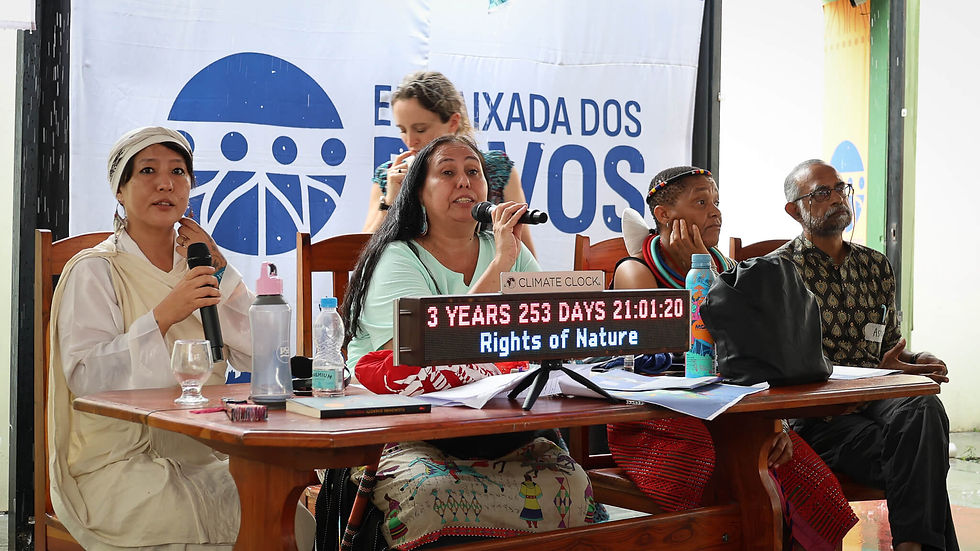
On November 10, the WECAN team was honored to participate in the GARN Indigenous Council Gathering, where Indigenous leaders from around the world gathered to share ancestral knowledge, discuss collective strategies, and strengthen cross-cultural alliances. The all day gathering included strong interventions and organizing by Casey Camp-Horinek (Ponca Nation), GARN Indigenous Council Chair, and Julia Horinek (Ponca Nation), Global North Organizer for the Indigenous Council, both of whom were on WECAN’s COP30 delegation.
WGC Pre-COP30 Strategy Meeting

On November 9, WECAN participated in the Women and Gender Constituency (WGC) strategy session with global feminists and women leaders. WECAN is a formal member of the WGC, and advocates alongside the constituency throughout the negotiations.
The Women and Gender Constituency (WGC) is one of nine stakeholder groups formally recognized by the UNFCCC, and includes 54 accredited organizations and a broader advocacy collective of over 1,000 individuals advancing gender equality and climate justice. During the meeting we prepared advocacy efforts for the negotiations and connected with the working group for the Just Transition Work Program. This year specifically we focused on the Gender Action Plan (GAP) and the Just Transition Work Programme (JTWP).

Final Session of the 6th International Rights of Nature Tribunal: A New Pledge for Mother Earth

The 6th International Rights of Nature Tribunal was held in parallel to COP30 on November 11, and exposed systemic harms and called for transformative legal frameworks that recognize the Rights of Nature. The Tribunal focused on stopping all fossil fuel extraction, ushering in a Just Transition, and the protection of land defenders. Hundreds of people joined to listen to Indigenous and frontline leaders, as well as Tribunal judges from all over the world as they discussed a new path forward through the Rights of Nature framework. Global victories were also shared as the event highlighted that over 39 countries are now engaged in Rights of Nature legislation.


“Let’s take to the streets, let’s get loud, let’s stop sugar coating what this moment is and what it demands of us. We must fight.” - Casey Camp-Horinek (Ponca Nation), Chair of the Indigenous Council for the Global Alliance for the Rights of Nature (GARN) and WECAN Board Member and Project Coordinator
Casey Camp-Horinek (Ponca Nation), WECAN COP30 Delegate and WECAN Board Member, Patricia Gualinga (Kichwa), WECAN COP30 Delegate and Program Coordinator in Ecuador, and Osprey Orielle Lake, WECAN Executive Director, served as Tribunal judges. The Tribunal judges presented and signed a “New Pledge for Mother Nature.” This outcome document calls for a profound civilizational shift and offers a framework for governments, civil society, and global institutions that gathered at COP30 to denounce fossil fuel extraction and large-scale mining that are direct threats to Mother Earth’s ecosystems and guardians. Learn more here.
In July of this year, the Inter-American Court of Human Rights (IACHR) issued a historic advisory, affirming Rights of Nature as essential for human rights. This important legal outcome sets a precedent for the actualization and implementation of Rights of Nature worldwide. Learn more about WECAN’s Rights of Nature work here.
In Action: Gender Justice Day at COP30

On the second day of the negotiations, meetings opened up on the Gender Action Plan, and feminists from the Women and Gender Constituency (WGC), made sure our demands were heard as we called for governments to implement gender, racial and economic justice in all policy streams.
The Women and Gender Constituency (WGC), a formal UNFCCC constituency that WECAN is honored to be a member of, organized a series of activities as part of Gender Justice Day and to highlight the Gender Action Plan (GAP), which is instrumental in catalyzing gender-transformative climate action under the Lima Work Program on Gender, a formal part of the negotiations.

The WGC advocated for a robust GAP that is fit for purpose, and strengthens the participation and leadership of women, girls, and gender-diverse peoples in climate action and policy-making. In addition to a morning caucus meeting with Ana Toni, COP30 CEO, Katherine Quaid (Confederated Tribes of Umatilla), WECAN Communications Director spoke at a press conference organized by the WGC, sharing key demands from the WGC Just Transition Work Program working group. Watch the Press Conference here.

Action to Launch the Belém Action Mechanism For Just Transition at COP30

Civil society held a collective action to demand the creation of a just transition mechanism as part of demands for the Just Transition Work Programme (JTWP) at COP30. Specifically at COP30, civil society demanded that Parties adopt the Belém Action Mechanism (BAM) for a Global Just Transition, which would transform the Just Transition principles currently in the work program into a coherent, supportive and actionable framework for Parties to advance Just Transition pathways. On day two of negotiations, constituencies came together to push, successfully, for the mechanism. Please see the analysis section of the blog for more details on civil society’s victorious efforts for a Just Transition mechanism.
Pavilion Event – Rights of Nature: Rewriting Climate Action through Ecosystem Resilience, Equity, and Regeneration
Co-hosted by WECAN, ThinkFilm, and the Global Alliance for Rights of Nature (GARN)

On November 12, WECAN co-hosted the event, “Rights of Nature: Rewriting Climate Action through Ecosystem Resilience, Equity, and Regeneration” at the Peru-Resilience Hub in the UNFCCC COP30 Blue Zone. WECAN, GARN, ThinkFilm, and ZinDoc, uplifted powerful Rights of Nature leaders who spoke out about how Nature's rights can transform the COP30 negotiations.
This session, inspired by the film “I Am The River, The River Is Me”, and co-hosted by WECAN, GARN, ThinkFilm, and ZinDoc, shared out successful case studies from the Rights of Nature movement that have demonstrated long-term solutions toward biodiversity protection, promoting community resilience and livelihoods, and building climate resilience. As one of the fastest growing environmental movements globally, Rights of Nature recognizes that Earth’s ecosystems have the right to exist and thrive while rejecting false solutions that attempt to commodify nature and threaten human and Indigenous rights. During this panel, expert leaders spoke to the transformative and influential strengths of how the Rights of Nature framework could transform the COP30 negotiations as it rejects false solutions, protects human and Indigenous rights, and builds climate resilience.
Speakers included: Casey Camp-Horinek (Ponca Nation), Chair of the Indigenous Council for the Global Alliance for the Rights of Nature (GARN), WECAN Board Member and Project Coordinator, Turtle Island/USA; Ned Tapas, Maori Elder and “I Am The River, The River is Me” protagonist, Whanganui, New Zealand; Osprey Orielle Lake, Executive Director of the Women’s Earth and Climate Action Network (WECAN), and GARN Executive Committee member, Turtle Island/USA; with moderation by Natalia Greene, Global Director of the Global Alliance for the Rights of Nature (GARN), Ecuador.
Press Conference – Women Leading Fossil Fuel Phaseout and A Just Transition

“The real solution is to stop investing in fossil fuels. We must invest instead in our health, our life and our liberation." - Colette Pichon Battle, Esq., Vision and Initiatives Partner for Taproot Earth, Lawyer and Climate Justice Activist, Turtle Island/USA
On November 13, during the WECAN Press Conference, “Women Leading Fossil Fuel Phaseout and A Just Transition,” global women leaders provided critical strategies to advance a fossil fuel phaseout, uplift and defend Indigenous and human rights, stop extraction, and implement a Just Transition that supports communities and ecosystems.
Speakers included: Dr. Ameria Sawas, Head of Research and Policy, Fossil Fuel Non-Proliferation Treaty Initiative, United Kingdom; Colette Pichon Battle, Esq., Vision and Initiatives Partner for Taproot Earth, Lawyer and Climate Justice Activist, Turtle Island/USA; gina cortés valderrama, climate, gender and economic justice expert, Colombia; Majo Andrade Cerda (Kichwa), Member of the Council of CONFENIAE, Leader of the Economy and Community Development area, Member of the Kichwa peoples of Serena, Federation of Napo Indigenous Organizations (FOIN), Ecuador; and Osprey Orielle Lake, Executive Director, Women's Earth and Climate Action Network (WECAN), Turtle Island/USA.
Press Conference – Indigenous Women from the Amazon: Urgent Action Calls to Protect Forests & Indigenous Rights

“It’s not only the Indigenous people that must have the responsibility to protect the forest. This is a call to action for all of us. We all need to do this together.” – Secretary Puyr Tembé (Tembé), First Secretary of State for Indigenous Peoples of Pará in the Brazilian Amazon and Co-founder of the National Association of Indigenous Women Warriors of Ancestry (ANMIGA), Brazil
On November 13, WECAN organized a press conference with esteemed Indigenous women leaders from three Amazonian countries mobilizing to protect Indigenous rights and biodiversity in the Amazon Rainforest, which is now at a critical tipping point. They brought forth calls to action and advocacy efforts to protect Indigenous rights, women land defenders, forests, water, communities, and the global climate. During the Press Conference, WECAN released “The Escazú Agreement Toolkits for Women Land Defenders and Frontline Communities.” The set of toolkits are designed to help women land defenders navigate their country's domestic laws to achieve the protections of the Escazú Agreement, and contain information specific to different countries in Latin America and the Caribbean, including: Brazil, Chile, Costa Rica, Guatemala, Mexico, Panama, Peru, Ecuador, Bolivia, Colombia, and Antigua and Barbuda.
Speakers included: Secretary Puyr Tembé (Tembé), First Secretary of State for Indigenous Peoples of Pará in the Brazilian Amazon, and Co-founder of the National Association of Indigenous Women Warriors of Ancestry (ANMIGA), Brazil; Patricia Gualinga (Kichwa), Kichwa leader from Sarayaku, Ecuador, Spokeswoman for Mujeres Amazónicas Defensoras de la Selva (Amazon Women in Defense of the Jungle), WECAN Coordinator Ecuadorian Amazon, Ecuador; Olivia Bisa Tirko (Chapra), President, Autonomous Territorial Government of the Chapra Nation (GTANCH), Peru; with moderation by Osprey Orielle Lake, Executive Director, Women’s Earth and Climate Action Network (WECAN), Turtle Island/USA.
Partner Panel — We Are Guardians
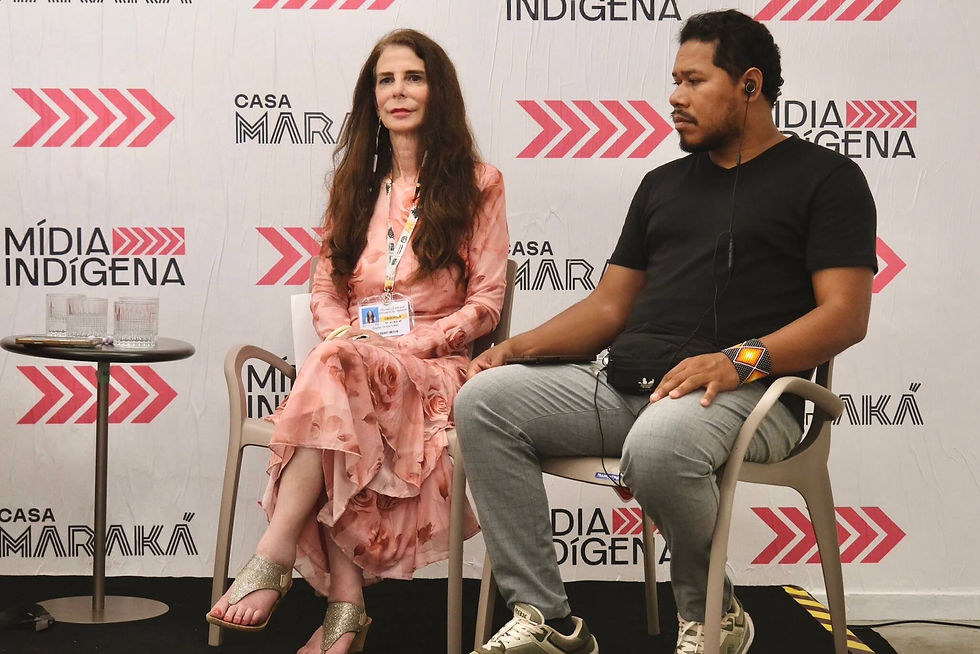

On November 14, WECAN participated in Afro and Indigenous Peoples Day at the ‘Nossa Aldeia at Casa Maraká, COP30’ by joining the ‘We Are Guardians’ panel, hosted by If Not Us Then Who and We Are Guardians. During this panel, co-directors Chelsea Greene and Edivan Guajajara, of We Are Guardians Film celebrated storytellers and forest defenders highlighting Indigenous leadership and planetary care. This panel explored the legacy, resilience, and innovation of Indigenous and Afro-descendant Peoples who have long safeguarded biodiversity and cultural heritage across the Global South.
Osprey Orielle Lake, spoke on the panel alongside WECAN Guajajara Forest Advisor, Edivan Guajajara and Chelsea Greene – both co-directors of the We Are Guardians film. During this discussion, WECAN highlighted the strength and power of Indigenous leadership in forest protection work, sharing specific Indigenous-led projects within our WECAN Women for Forest program. The team also took this time to meet with Lídia Guajajara, WECAN Guajajara Project Coordinator, of the WECAN Reforestation and Forest protection project in Guajajara Territory, Brazil, who was also a member of the WECAN COP30 delegation.
Green Zone Event — Parliamentarians and Global Defenders Leading a Just Transition and Climate Solutions to Promote the Paris Agreement and Climate Justice

On November 14, WECAN collaborated on a COP30 Green Zone Event, hosted by Federal Deputy Célia Xakriabá, “Parliamentarians and Global Defenders Leading a Just Transition and Climate Solutions to Promote the Paris Agreement and Climate Justice.” This discussion sought to highlight the central role of women political leaders and defenders of human rights in construction of a just, inclusive and supportive transition. The debate addressed how the implementation of the Paris Agreement must be anchored in principles of climate justice, social equity and protection of people and territories. Led by Representative Célia Xakriabá, the discussion aimed to strengthen alliances between the Global South and grassroots movements, expanding political advocacy in defense of environmental rights, people's sovereignty and a fair climate future. Osprey Orielle Lake, WECAN Executive Director, spoke at this event about our work connecting grassroots and government women leaders for climate action. We are honored to work in collaboration with Federal Deputy Célia Xakriabá and to have joined this critical discussion.

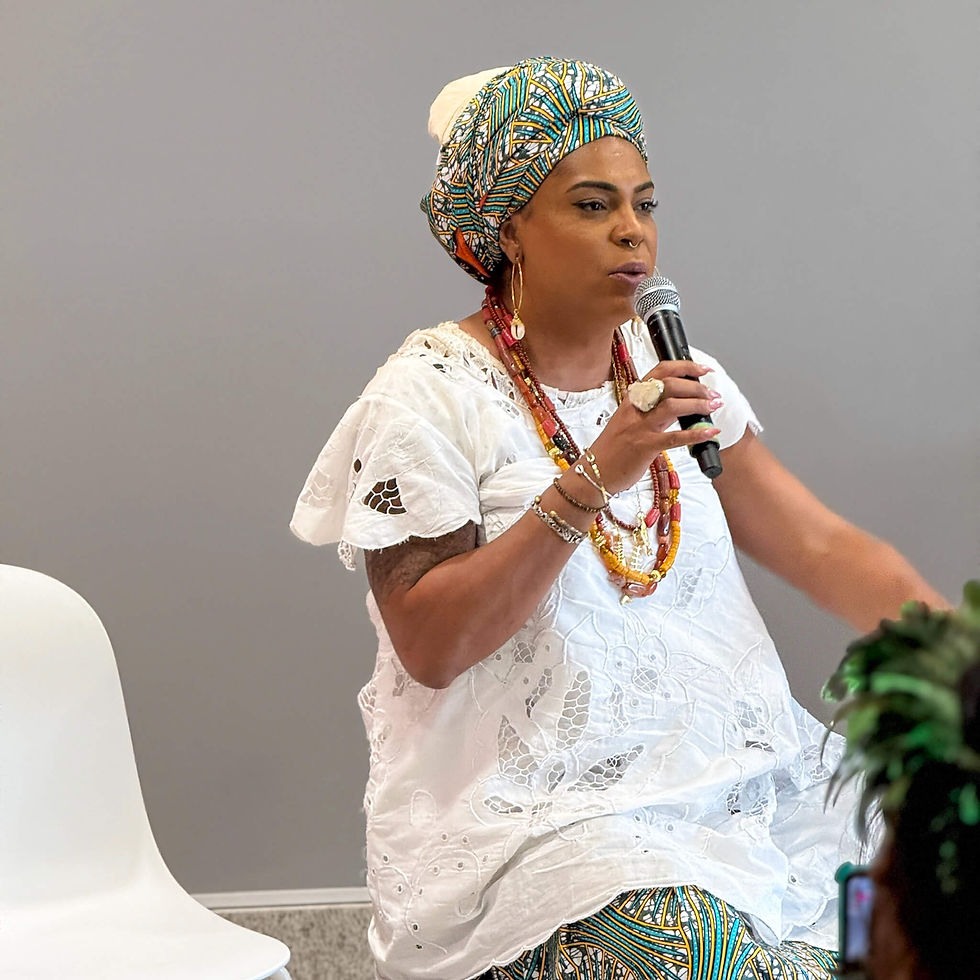
Speakers included: Célia Xakriabá, Federal Deputy for the state of Minas Gerais and co-founder of the National Articulation of Indigenous Women Warriors of Ancestry (ANMIGA); Osprey Orielle Lake, Founder and Executive Director of the Women’s Earth and Climate Action Network (WECAN); Kathrin Henneberger, Former member of the German Parliament; Carolina Santana, socioenvironmental lawyer with a PhD in Constitutional Law and Democracy, with 10 years of work in the Federal Executive Branch; Rosa Amorim, State Deputy in Pernambuco State Assembly, and Chair for both the Parliamentary Front to Combat Hunger and the Committee on Environment, Sustainability, and Animal Protection; Juhlia Santos, Councilwoman in the City Council of Belo Horizonte; and other representatives who joined from the audience.

Cúpula dos Povos – The People’s Summit

From November 12–16, The Cúpula dos Povos, or the People’s Summit, gathered more than 24,000 Indigenous peoples, traditional communities, women, youth, workers, and social movement leaders from across Brazil and around the world. What emerged was not simply a parallel event to COP30, but a powerful convergence two years in the making, a deliberate and collaborative process rooted in ancestral knowledge, feminist values, and deep movement-to-movement solidarity. Built by an extraordinary constellation of Brazilian social and popular organizations, and international allies, the Summit brought people together in a way that co-created an autonomous, people-centered space.
Across assemblies, testimonies, cultural gatherings, and strategy sessions, the Summit became a vital home for those most impacted by extraction, authoritarianism, environmental racism, and the erosion of territorial rights. Together, they articulated a vision for a just and popular transition; one defined by the full demarcation of Indigenous territories, zero deforestation, an end to the fossil fuel era, demilitarization, food sovereignty, community-governed and democratized climate finance, and real accountability for corporate and state harm.
Above all, the People’s Summit reminded the world that transformative climate action will not come from negotiation halls alone. It will come from frontline communities and global civil society organizing with persistence, imagination, and unity, insisting on solutions that are anti-racist, anti-colonial, feminist, and grounded in the defense of land, water, and life. WECAN engaged in and co-hosted activities at the People’s Summit.
The People’s Summit Opening Ceremony: Barqueata arrival of “The Answer” Caravan to Belém

On November 12, the WECAN team joined the opening of the Cúpula dos Povos to witness the arrival of the Barqueata and The Answer Caravan — a mass convergence of river boats and delegations traveling from across the Amazon River and beyond. Some boats came from Brazil’s soy frontier, drawing urgent attention to the destructive expansion of industrial soy, while other boats journeyed from territories throughout the Amazon impacted by oil and mining extraction, and other exploitative projects. Nearly 200 vessels carrying more than 5,000 Indigenous, riverine, quilombola, and social movement leaders filled the waters along the Guajará Bay in a historic call for climate and territorial justice. Among those arriving were Indigenous leaders from across the Amazon, including Chief Raoni of the Kayapó People, alongside movements and allies from more than 60 countries.
We Are Nature: A Web of Knowledge on the Rights of Nature in the World
Hosted by Global Alliance for Rights of Nature (GARN), WECAN, and other Rights of Nature partners

During the People’s Summit, GARN, WECAN, and other Rights of Nature partners co-hosted the event, “We Are Nature: A Web of Knowledge on the Rights of Nature in the World.” This gathering fostered rich and inspiring dialogue among Indigenous leaders, legal experts, and activists from around the globe. Together, participants explored how the Rights of Nature framework is advancing across diverse territories as a powerful legal, cultural, and political tool for protecting ecosystems and defending communities on the frontlines of extractivism.
People’s Summit Public Hearing with COP30 President, André Corrêa do Lago
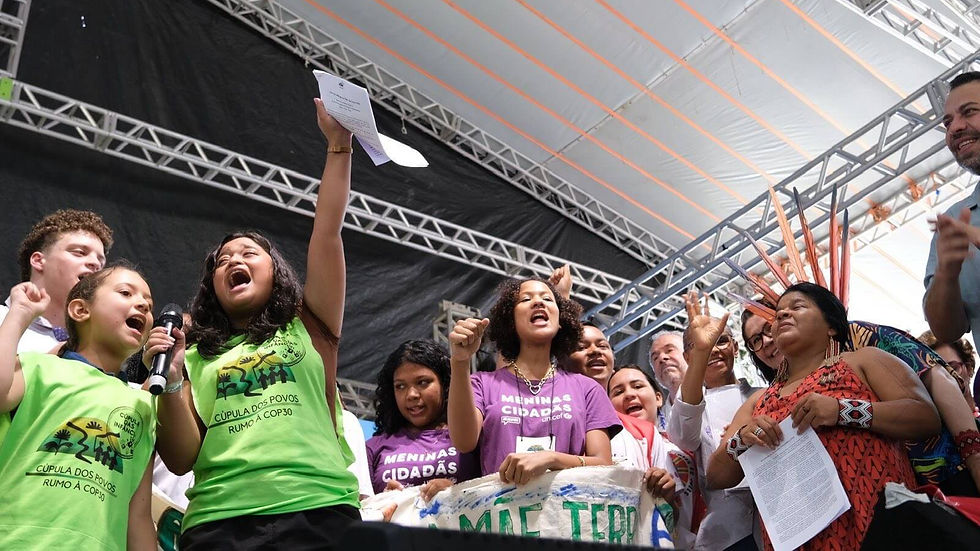
At the closing of the People’s Summit, a diverse group of representatives delivered the Declaration of the People’s Summit Towards COP30, to the COP30 Presidency, including COP President André Corrêa do Lago, COP30 Executive Director Ana Toni, Minister of the Environment and Climate Change and of the Global Ethical Balance Marina Silva, and Minister of Indigenous Peoples of Brazil Sonia Guajajara. After more than two years of collective organizing, communities of the Global South and those on the frontlines of environmental racism around the world called for the resolute and full demarcation of Indigenous territories, no deforestation, a truly just and feminist transition, demilitarization, an end to the era of fossil fuels, public financing that actually reaches communities, and real accountability for corporate and state environmental harm.
Actions to End Fossil Fuels
Both inside and outside the COP30 negotiations, Indigenous leaders and civil society mobilized in powerful unity, calling for a definitive end to the fossil fuel era. With over 1,600 fossil fuel lobbyists present the message could not be clearer: it is far past time to kick big polluters out and allow the voices of the people to lead. Please see the analysis section above for WECAN’s report back on fossil fuel phaseout within the COP negotiations. Below find photos from several actions taken over the two weeks of COP to demand fossil fuel phaseout for people and communities.


Global Day of Action for Climate Justice

On Saturday, November 15, WECAN marched and chanted through the streets of Belém at the Global Day of Action March. Indigenous communities, frontline communities, workers, international groups, and many more were there to bring forth calls to action to demand justice for people and the planet. The Global Day of Action was also part of the People’s Summit (listed above), and brought together more than 70,000 people in action. In the face of climate catastrophes, threats to democracy, violations of human and Indigenous rights, and the destruction of nature, we stand as a united front calling for a better world.


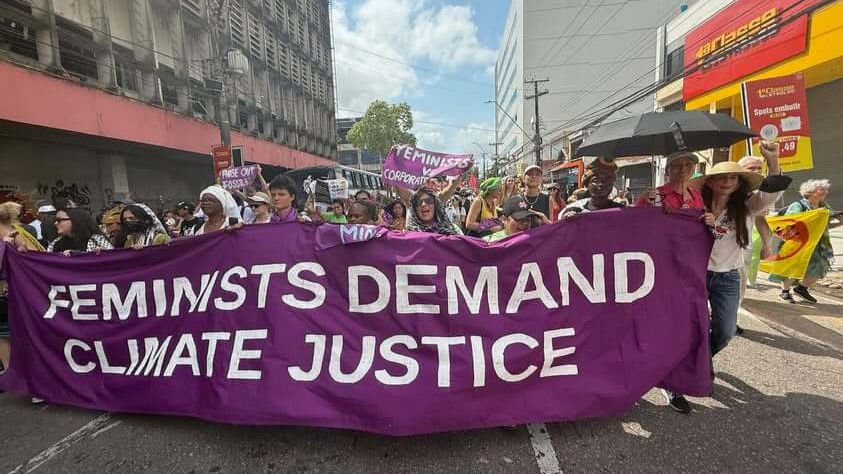

From the Sea of Rio92 to the Waters of Belém30 — Women for Climate Flotilla

At this historic milestone gathering, women leaders from feminist, Amazonian, Black, and Indigenous movements came together and reflected on the collective journey toward a climate-just future that embodies care, equity, and resilience. This powerful Women for Climate flotilla event honored over three decades of feminist climate justice movements, from the Earth Summit held in Rio in 1992 to the waters of the Amazon in Belém at COP30.
The event included a press conference, panel, water ceremony, and celebration that honored global feminist mobilization. Embroidered letters reaffirming commitments to care for the Earth, ribbons, seeds, and flowers were amongst the symbols of regeneration, reflection and respect that decorated the boat. It was a poignant moment that connected our movements across the globe and throughout history, and replenished our commitments to resistance and joy.
Joining the event were feminist leaders from Latin America as well as Brazilian representatives, including the Minister of Indigenous Peoples Sonia Guajajara, Federal Deputy Célia Xakriabá, Rachel Barros from the Ministry of Racial Equality and Eutalia Barbosa from the Ministry of Women. Casey Camp-Horinek (Ponca Nation), Ponca Nation Environmental Ambassador and WECAN Board Member and Delegate, and Osprey Orielle Lake, WECAN Executive Director, both of whom spoke during the event, shared global solidarity with Indigenous Peoples and women-led movements, and the vital need for systemic change.


Women’s Leadership for the Health of People and Planet
Co-hosted by WECAN and If Not Us Then Who

On November 16, WECAN co-hosted a powerful and inspiring event alongside If Not Us Then Who, which brought together frontline and Indigenous women leaders and global advocates to share the many frameworks, approaches, and solutions taking place worldwide regarding living in reciprocity and well-being with Nature. Together, women in all of their diversity addressed the root causes of the interlocking biodiversity and climate crises, while creating space for deep reflection, understanding, and connection by weaving together the wisdom of cultural traditions with urgent political calls to action. The evening’s conversation centered on transformative and healing women-led solutions and strategies for defending the rights of women land defenders and protecting the sacred web of life. The event also celebrated the recent news that Ecuadorian voters rejected the proposal to rewrite their constitution, which would have dismantled the Rights of Nature and caused other significant societal and environmental hardships.
Speakers included: Federal Deputy Célia Xakriabá (Xakriabá), Federal Deputy in Brazilian Congress in the state of Minas Gerais, and Co-founder of the National Association of Indigenous Women Warriors of Ancestry (ANMIGA), Brazil; Casey Camp-Horinek (Ponca Nation), Ponca Nation Environmental Ambassador and WECAN Board Member and Project Coordinator, Turtle Island/USA; Patricia Gualinga (Kichwa), Kichwa leader from Sarayaku, Ecuador, Spokeswoman for Mujeres Amazónicas Defensoras de la Selva (Amazon Women in Defense of the Jungle), WECAN Coordinator Ecuadorian Amazon, Ecuador; Irenne Toqueton Vargas (Sapara), Leader from the Sapara Nation, Mujeres Amazónicas Defensoras De La Selva (Amazon Women in Defense of the Jungle), Ecuador; Noemi Gualinga Montalvo (Kichwa), Kichwa leader from Sarayaku, Mujeres Amazónicas Defensoras De La Selva (Amazon Women in Defense of the Jungle), Ecuador; Silvinha Xukuru (Xukuru), Seed Woman from the National Association of Indigenous Women Warriors of Ancestry (ANMIGA); with moderation by Osprey Orielle Lake, Executive Director, Women's Earth and Climate Action Network (WECAN), Turtle Island/USA.
Formal UN Side Event — Women for Climate Justice Leading Solutions on the Frontlines of the Climate Crisis

“What we’re doing here is for the right of life itself. We are planting seeds of life.” – Concita Sõpré, ANMIGA Co-founder, and FEPIPA Co-founder, Brazil
During WECAN’s Formal UN Side event, “Women for Climate Justice Leading Solutions on the Frontlines of the Climate Crisis”, hosted on November 17, women leaders from around the world offered climate justice strategies and solutions to support a fossil fuel phaseout and accelerate a Just Transition. Topics included forest protection and restoration, feminist climate finance, Indigenous rights, Rights of Nature, women land defenders, campaigns to hold governments accountable, and vital updates on the COP30 negotiations.

Speakers included: Lidia Guajajara (Guajajara), Indigenous Climate Activist and Communicator from Araribóia Indigenous Territory in the state of Maranhão and WECAN Coordinator in Brazil, Brazil; Casey Camp-Horinek (Ponca Nation), Ponca Nation Environmental Ambassador, WECAN Board Member and Project Coordinator, and Chair of the GARN Indigenous Council, Turtle Island/USA; Zukiswa White, Gender Advisor, African Women’s Development and Communication Network (FEMNET), South Africa; Xiye Bastida (Otomi-Toltec), Co-Founder and Executive Director of the Re-Earth Initiative, Mexico; Eriel Deranger (Athabasca Chipewyan First Nation), 2024 Climate Breakthrough Award Winner, Turtle Island/Canada; Concita Sõpré, Co-founder, National Association of Indigenous Women Warriors of Ancestry (ANMIGA), and Co-founder of the Federation of Indigenous Peoples of the State of Pará (FEPIPA), Brazil; with comments and moderation by Osprey Orielle Lake, WECAN Executive Director, Turtle Island/USA.
Indigenous March in Belém

On November 17, WECAN joined the Global Indigenous March that united Indigenous voices from different territories in the campaign 'The Answer is Us'. This marked the second week of COP30 in Belém, Brazil, as Indigenous organizations, leaders, and allies called for an end to extractivism, environmental dismantling, and territorial violence. Demarcation now! Indigenous Rights are a Climate Solution! Learn more: https://theanswerisus.org
Indigenous Rights Action inside the UNFCCC

On November 18, Indigenous Peoples held an action inside the Blue Zone of COP30, sharing calls from Indigenous Peoples all across the world. Speakers spoke out about the impacts of the climate crisis, fossil fuels, and false solutions, while urgently demanding their rights, sovereignty, and leadership be upheld and respected within the negotiations. On Indigenous People’s Day in COP30, WECAN also released our policy brief, “Indigenous Rights are Vital to a Healthy and Just World: Guidance and Recommendations for the UNFCCC and Governments.”

Press Conference — Rights of Nature: A Systemic Solution to the Climate Crisis

“We don't have fragile ecosystems. We have fragile imaginations of human beings. We need to recover the fact that we are one and a part of nature, and we should relate with her in a way that shows respect.” - Nnimmo Bassey, Member of the GARN Executive Committee, and Director of Health of Mother Earth Foundation, Nigeria
On November 18, WECAN hosted a press conference, “Rights of Nature: A Systemic Solution to the Climate Crisis,” which showcased how Rights of Nature articulates a new legal framework and economy based on living in balance with Earth’s natural systems. Speakers shared successes from the Rights of Nature movement, and how it can offer a systemic framework for defending biodiversity, communities, and our climate.
During the press conference, WECAN also released our policy brief, "Rights of Nature as a Central Pillar of a Just Transition,” which examines how incorporating a Rights of Nature legal and cultural framework into a Just Transition is critical to global responses to the climate crisis. Read the full WECAN report here.
Speakers included: Casey Camp-Horinek (Ponca Nation), Ponca Nation Environmental Ambassador, WECAN Board Member and Project Coordinator, and Chair of the GARN Indigenous Council, Turtle Island/USA; Nnimmo Bassey, Historical Member of the GARN Executive Committee, and Director of Health of Mother Earth Foundation, Nigeria; and Osprey Orielle Lake, WECAN Executive Director, and GARN Executive Committee Member, Turtle Island/USA.
Pavilion Event — We Are Nature: Indigenous Leadership for the Rights of Nature
Hosted by the Indigenous Council for the Global Alliance for the Rights of Nature

During this event on November 18, members of the Indigenous Council for the Global Alliance for the Rights of Nature (GARN) shared ongoing advocacy efforts to ensure permanent compliance with the principles of reciprocity with Nature, which is part of the Indigenous cosmovision.
This gathering served as a vital space for Indigenous communities and allies to explore the deep connection between the Rights of Nature and Indigenous sovereignty. Grounded in Indigenous cosmovisions, which see Nature as a living entity with inherent rights, this event highlighted the importance of centering Indigenous knowledge and leadership in global environmental governance, and how Rights of Nature can support ongoing efforts for Indigenous sovereignty and climate action. Panelists discussed the critical role of Indigenous peoples in shaping international policy dialogues at COP30 and going forward.
Speakers included: Casey Camp Horinek (Ponca Nation), GARN Indigenous Council Chairwoman; Julia Horinek (Ponca Nation), GARN Global North Indigenous Organizer; Leo Cerda (Kichwa), GARN Global South Indigenous Organizer; and Quetza Ramirez, GARN Youth Hub Facilitator.
Press Conference — Women on the Frontlines of Climate Action

"COP30 must deliver on climate action or get out of the way of those of us who are, who have, and who will continue to [deliver on climate action]. History and humanity are on our side. We will win." - Zukiswa White, Gender Advisor, African Women’s Development and Communication Network (FEMNET), South Africa
On November 18, WECAN hosted a COP30 press conference, “Women on the Frontlines of Climate Action”, which featured powerful interventions from global women leaders on how women are taking action and leading the way to end fossil fuels, ensure rights-based approaches in the Just Transition, call for Indigenous Peoples' rightful spot at the negotiating table, progress climate negotiations at COP30, and build a world defined by justice.
At the event, WECAN also delivered our policy brief, “Justice-Based Climate Finance for COP30 and Beyond,” which provides in-depth analysis and strategies for governments to address the ongoing climate crisis and advance effective, rights-based climate finance. Read the full WECAN report here.
Speakers included: Susana Muhamad, former Minister of Environment and Sustainable Development of Colombia and Special Envoy for the Fossil Fuel Treaty Initiative; Zukiswa White, Gender Advisor, African Women’s Development and Communication Network (FEMNET), South Africa; Casey Camp-Horinek (Ponca Nation), Ponca Nation Environmental Ambassador and WECAN Board Member and Project Coordinator, Turtle Island/USA; Taily Terena (Terena Nation), Pantanal, Brazil; Comments and moderation by Osprey Orielle Lake, Executive Director, Women's Earth and Climate Action Network (WECAN), Turtle Island/USA.
GEDA Event — Transforming Climate Action at COP30 and Beyond: Accelerating Inclusive Progress Through Gender Data
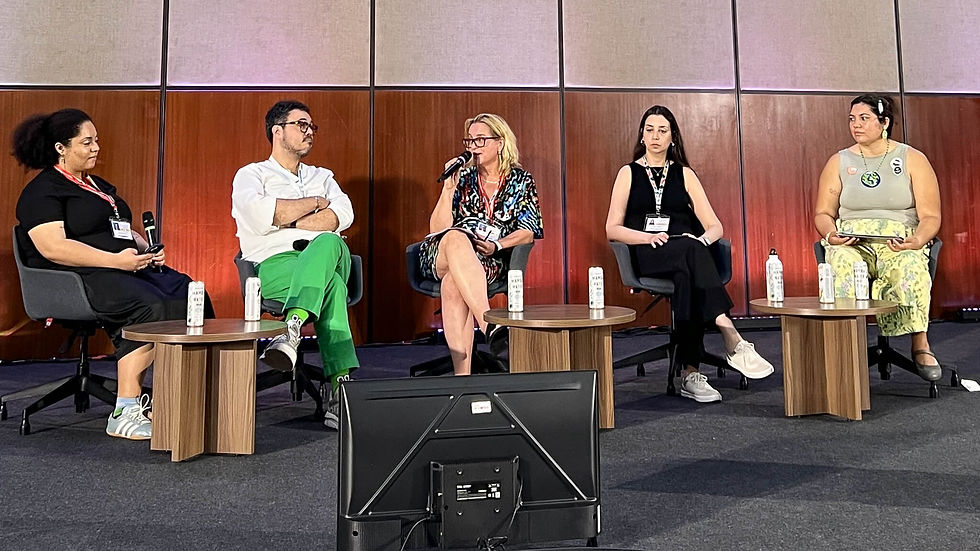
On November 18, the Gender and Environment Data Alliance (GEDA) hosted a special side event to highlight innovative data practices at the intersection of gender and the environment that can inform decisions around policy, financing, and monitoring progress. Through a panel discussion, flash presentations, and interactive dialogues, this event demonstrated how data is essential to advancing every aspect of the Paris Agreement and is critical for inclusive and evidence-informed climate action.
Katherine Quaid (Confederated Tribes of Umatilla), WECAN Communications Director, spoke on the panel about the ways gender-disaggregated data can support the advancement of the Just Transition Work Program in the UNFCCC. She also shared the fifth edition of WECAN’s report, “The Gendered and Racial Impacts of the Fossil Fuel Industry in North America and Complicit Financial Institutions,” which addresses the disproportionate gender and race-specific health and safety impacts as well as human and Indigenous rights issues of fossil fuel extraction and infrastructure in the United States. Learn more about the report here. WECAN is honored to be a part of GEDA, a membership alliance that serves as a hub for diverse organizations working on the intersection of gender and environment through a data lens.
Pavilion Event – Guardians of the Future: Women Leading Forest Protection & Cultural Resilience
Co-hosted by WECAN and We Are Guardians

On November 19, WECAN and We Are Guardians hosted a productive and inspiring event, “Guardians of the Future: Women Leading Forest Protection & Cultural Resilience” in the Climate Live & Entertainment + Culture Pavilion at COP30. During the event, frontline and Indigenous women leaders from the Amazon, along with international advocates, showcased successful women-led solutions and strategies for reforesting and protecting ancestral territories. Specifically, WECAN highlighted our successful Women for Forest Programs in the Ecuadorian and Brazilian Amazon. The robust discussion demonstrated how women are defending the Amazon by embodying the principles of reciprocity, respect for nature, and intergenerational stewardship, grounded in rights-based frameworks, cultural practices and Traditional Ecological Knowledge systems. Critical analysis was shared about why market based mechanisms are not a forest solution and how it is vital to end the financialization of nature and instead lift up community-led solutions. Learn more about the WECAN Women for forests program here.
WECAN also released our new video, “Indigenous women of Sarayaku Nurturing and Restoring the Ecuadorian Amazon Rainforest”:
Speakers Included: Secretary Puyr Tembé (Tembé), First Secretary of State for Indigenous Peoples of Pará in the Brazilian Amazon, and Co-founder of National Association of Indigenous Women Warriors of Ancestry (ANMIGA), Brazil; Patricia Gualinga (Kichwa), Kichwa leader from Sarayaku, Spokeswoman for Mujeres Amazónicas Defensoras de la Selva (Amazon Women in Defense of the Jungle), WECAN Coordinator Ecuadorian Amazon, Ecuador; Lidia Guajajara (Guajajara), Indigenous Climate Activist and Communicator from Araribóia Indigenous Territory in the state of Maranhão and WECAN Coordinator in Brazil, Brazil; Osprey Orielle Lake, Executive Director, Women's Earth and Climate Action Network (WECAN), Turtle Island/USA; and moderation and comments by Chelsea Greene, We Are Guardians Film Co-Director and Impact Producer, Turtle Island/USA.
Virtual Event — Global Voices and Women-Led Calls to Action in Response to COP30
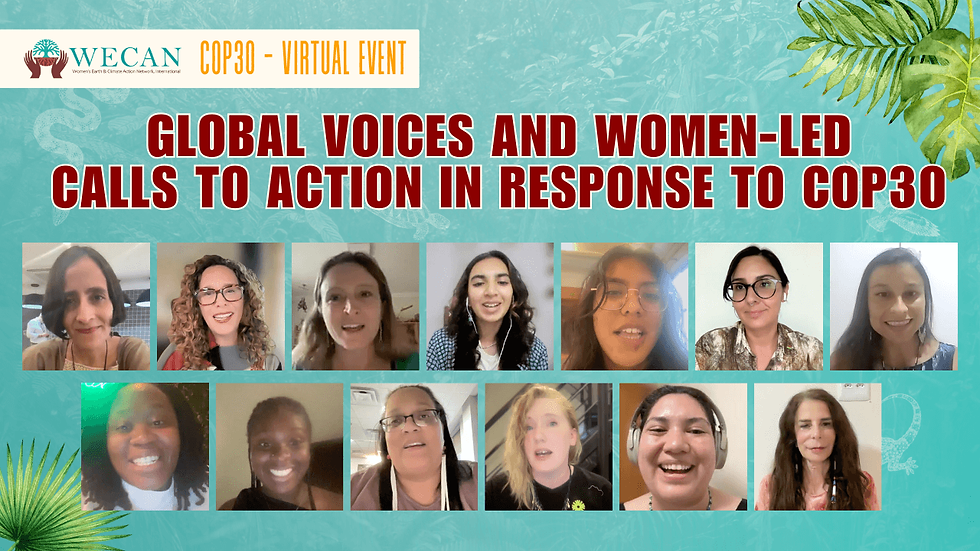
From Belém and beyond, women leaders in all of their diversity joined WECAN for a dynamic, virtual event on November 20 in the final days of COP30 to share reflections on the negotiations and calls to action in response to COP30. Around the world, people’s movements are responding to the escalating climate crisis, rising to address the urgency and needs of people and the planet.
Speakers included: Susana Muhamad, Former Minister of Environment and Sustainable Development of Colombia, and Special Envoy for the Fossil Fuel Treaty Initiative; Tzeporah Berman, Chair, Fossil Fuel Non-Proliferation Treaty, Canada; Ayshka Najib, Women and Gender Constituency (WGC) Just Transition Working Group, Fridays For Future MAPA, UNICEF Youth Advocates, United Arab Emirates (UAE); Maria Reyes, Climate and Human Rights Activist and Fundraising Coordinator of the Alliance of Non Governmental Radical Youth (ANGRY), Mexico; Natalia Greene, Global Director of the Global Alliance for the Rights of Nature (GARN), Ecuador; Eriel Deranger (Athabasca Chipewyan First Nation), President of Indigenous Climate Action, 2024 Climate Breakthrough Award Winner, Turtle Island/Canada; Laura Cook, Project Dandelion Senior Strategist, Climate Policy & Narrative, United Kingdom; Sheelah Bearfoot (Chiricahua Apache), MHS, Environmental Health and Justice Program Manager, Poetry for Planet, Turtle Island/USA; Zukiswa White, Gender Advisor, African Women’s Development and Communications Network, (FEMNET), South Africa; Dr. Crystal A. Cavalier-Keck Ed. D., MPA (Occaneechi Band of the Saponi Nation), Co-Founder and CEO of 7 Directions of Service, and Chapter Director of the 17 Rivers American Indian Movement (AIM), Turtle Island, USA; Cheryl Kwapong, The Chisholm Legacy Project and Global Afrodescendants Climate Justice Collaborative, Turtle Island/USA; Katherine Quaid (Confederated Tribes of Umatilla), Communications Director, Women’s Earth and Climate Action Network (WECAN), Turtle Island/USA; with comments and moderation by: Osprey Orielle Lake, Executive Director, WECAN.
Final Days Actions for Fossil Fuel Phaseout and Just Transition

During the final days of COP30, when the draft negotiating text was released with all fossil fuel phaseout language removed across every track — including the Mutirão cover text — civil society immediately mobilized. A series of powerful actions unfolded throughout the venue, making clear that removing the heart of climate ambition was unacceptable. Civil society and climate vulnerable countries in alignment with science have long affirmed that to keep 1.5°C alive and to safeguard our collective future, countries must enact a fossil fuel phaseout now. There is no “later.”

There was also a powerful Just Transition action before the start of the People’s Plenary, where civil society strategically — and joyfully — raised collective calls for a Just Transition and transformative systemic change. The WECAN team was on the ground throughout the day, participating in these urgent demands to end the era of fossil fuels, adopt a mechanism for the Just Transition Work Program, and maintain pressure until the final decision text was reached. A livestream of this action can be found here.
UNFCCC Constituencies COP30 People’s Plenary

In the final days of COP30, on November 21, UNFCCC constituencies held the People’s Plenary, where each constituency speaks out, uplifting our collective calls for justice, action, and global solidarity. This is a moment at the end of each COP to reflect on our shared power as civil society and to truly honor the grief, the care, and the love we share for our communities, ecosystems, and global planet. It is also a time to plan for the final stages of the negotiations collectively.

The Plenary opened with a mística led by Indigenous women leaders, followed by powerful and moving statements from Palestinian and Sudanese activists. Representatives from the many civil society caucuses, including trade unions, the disability caucus, Indigenous Peoples caucus, farmers, ENGO, and the Women and Gender Constituency shared their calls for action. The plenary closed with a song led by Indigenous youth, who also carried a sign to bring attention to the recent murder of Guarani Kaiowá leader, Vicente Fernandes Vilhalva.

HONORING COLLEAGUES
WECAN was honored to connect, strategize, and build with many partners and colleagues within Brazil and around the world. Please see below a few highlights of partners and colleagues at COP30.


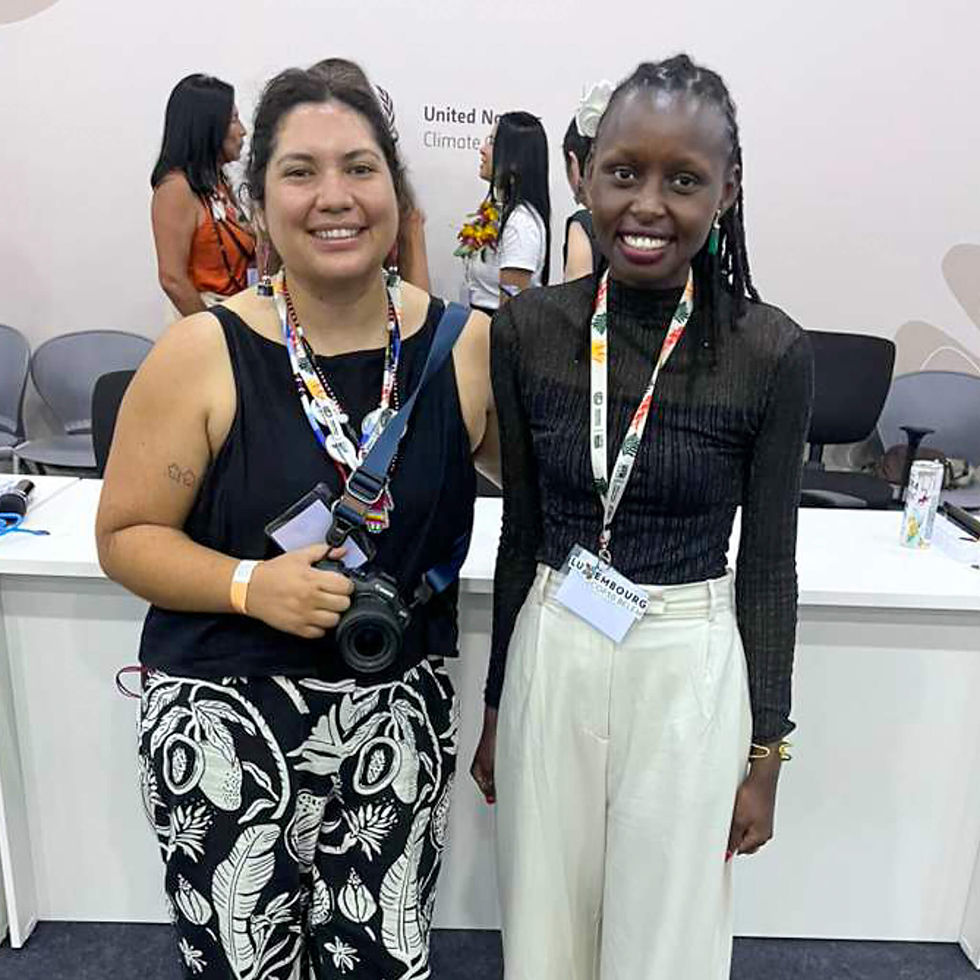


WECAN COP30 DELEGATION
WECAN was honored to facilitate, accompany, and uplift the presence of an incredible group of frontline and Indigenous women leaders at COP30, who advocated for climate justice and led and participated in powerful actions, announcements, advocacy interventions, press conferences, high-level engagements, and events over the duration of their time at the conference. Meet the WECAN COP30 Delegation here!
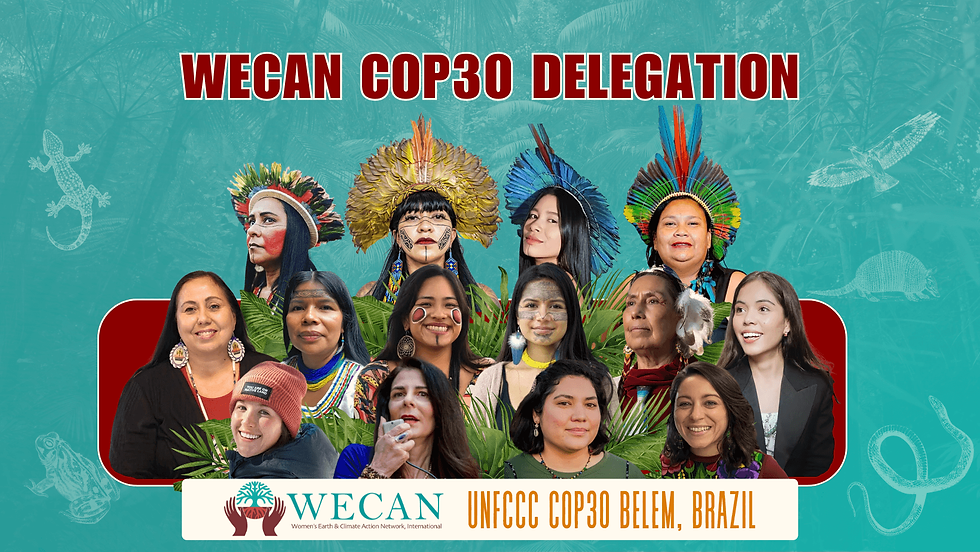
MEDIA ROUNDUP
Media requests for the Women’s Earth and Climate Action Network regarding our events and advocacy at the UNFCCC COP30 can be directed to: katherine@wecaninternational.org
During COP30 WECAN had 62 media hits highlighting our work and the WECAN COP30 Delegation. Please see the media hits here!