


JUST TRANSITION & CLIMATE RESILIENCE
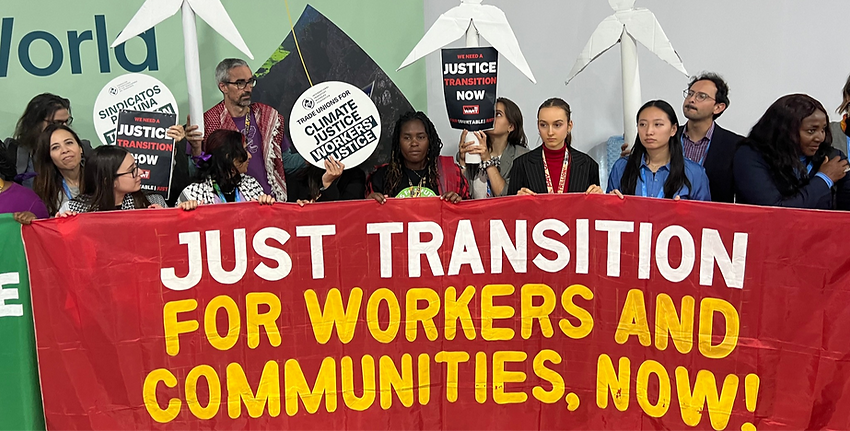
Civil society gathered at COP29 to demand a Just Transition. Photo credit: WECAN / Katherine Quaid
The Just Transition is a principle, a process, and a practice that ensures the transition to a low-carbon society upholds human rights and ecological integrity. The concept was initially founded by labor unions and environmental justice movements that recognized the need to transition away from polluting industries, while also securing economic and societal protections for workers and communities in the fossil-free future. Champions of early Just Transition strategies fought for skills retraining for workers, income support, and safe jobs in low-carbon sectors. These demands served as a critical foundation for the Just Transition movement, which has since expanded to encompass a holistic, systemic approach to the low-carbon transition that upholds human and ecological wellbeing. Women in all their diversity, Indigenous Peoples, Afro-descendants, communities from the Global South, and environmental justice communities have long fought for intersectional Just Transition policies that address the root causes of the climate crisis and champion equitable climate solutions.
Today, the Just Transition is more expansive and includes and also goes beyond decarbonizing the economy. It is about transitioning communities away from polluting and extractive activities and building new relationships that prioritize care, equity, reciprocity, and harmony with nature. This work is crucial in combating the climate crisis, as it addresses the root causes of social injustice and environmental degradation. It ensures that the transition away from fossil fuels upholds human rights and works within planetary bounds. Already, humans have crossed seven of the nine planetary boundaries critical for maintaining a stable ecosystem and sustaining human life. As a result, approximately 3.3 to 3.6 billion people are living in contexts at high risk of climate impacts. At the same time, many fossil fuel companies, governments, and financial institutions are promoting false solutions to the climate crisis that perpetuate extractive industries, violate human rights, and do not address greenhouse gas emissions at their source. The Just Transition is essential for rejecting these false solutions and instead enacting a profound cultural and economic shift that prioritizes people and the planet.
_edited.jpg)
WECAN at Climate Week in NYC, September 2025.
Women in all their diversity have been integral to Just Transition movements since their inception. Although patriarchal systems and gender discrimination render women disproportionately vulnerable to many climate impacts, they are champions of transformative climate solutions. Feminist advocates have long pushed for socioeconomic frameworks that value ecological regeneration, community stewardship, and care. Care work, including paid and unpaid healthcare, child rearing, cleaning, and education, is integral to the Just Transition. By prioritizing human wellbeing within planetary bounds over material economic growth, care economies help build climate-resilient communities.
WECAN is engaged in Just Transition movements worldwide to advance climate justice solutions that uplift community well-being, ecological balance, and respect for human rights. WECAN’s Just Transition advocacy intersects with the following frameworks, activities, and solutions:
-
Food sovereignty and security
-
Rights of Nature
-
Indigenous and human rights
-
Feminist economies and care work
-
Democratized, decentralized, renewable energy access
-
Research and policy briefs
-
Landback efforts
-
Mutual aid hubs
-
Training Workshops
See below for more details on WECAN’s Just Transition programs.
Ponca Earthen Lodge Project

The Pa'tha'ta Women's Society of the Ponca community steward the Earthen Lodge as part of the WECAN Earthen Lodge project. Photo credit: WECAN / Katherine Quaid
Despite living on the frontlines of the climate crisis and extractive industries, Indigenous women lead cultural and ecological Just Transition movements. With Indigenous Ponca Nation Environmental Ambassador, Casey Camp-Horinek, and the Pa'tha'ta Women's Society in the Ponca community, WECAN partnered to launch the Ponca Earthen Lodge Project for an Indigenous Just Transition. The Ponca Nation is situated in Oklahoma, where decades of fracking, pipelines, petrochemical plants, and oil refineries pose a significant threat to the health and well-being of the community. Grounded in Indigenous wisdom and knowledge of the Ponca Nation, the Earthen Lodge was constructed in 2023 on Ponca land to serve as a vital source of community spiritual, cultural, and physical resilience.
Droughts, heatwaves, and climate disasters, such as tornadoes, are expected to worsen throughout Oklahoma. As the climate crisis escalates, the need for safe sanctuary that can house and support frontline communities continues to grow. This Just Transition and Climate Resilience project responds to the extraction and climate disasters in Ponca, through climate resiliency, food sovereignty, and Indigenous cultural knowledge and practices. The Earthen Lodge Project not only supports traditional food and medicine stewardship, but also provides shelter against natural disasters exacerbated by the climate crisis.
You can also learn more about the Earthen Lodge Project in the video below:
Okla Hina Ikhish Holo
People of the Sacred Medicine Trail
.jpg)
WECAN Okla Hina Ikhish Holo team members hold a banner reading “Food Justice is Climate Justice: Protecting Land, Seeds, and Communities,” in the Gulf South. Photo Credit: WECAN
At the end of the Mississippi River, in the place the Chahta (Choctaw) call Bvlbancha, the Okla Hina Ikhish Holo, People of the Sacred Medicine Trail, a network of femme and nonbinary Indigenous gardeners, is working urgently to respond to the climate crisis. This is a powerful WECAN Indigenous-led Just Transition project building climate-resilient systems rooted in ancestral knowledge, land stewardship, food sovereignty, local economies, and mutual aid.
The project flourishes along re-established Indigenous trade routes, where the Okla Hina Ikhish Holo Collective has built farms, gardens, greenhouses, earthen mounds, and community shelters – all supporting an agro-ecological movement that promotes biodiversity, community care, and food justice as key components of climate justice and a Just transition.
You can also learn more about the Okla Hina Ikhish Holo Project in the video below:
Just Transition Narratives, Reports & Analyses
WECAN conducts and produces research, reports, and policy briefs highlighting critical Just Transition issues. See our latest reports, toolkits, and policy analyses here. Please see highlights of several Just Transition-focused reports below.

Circular, Equitable, and Renewable: Scrutinizing Mineral Requirements to Build a Just Energy Transition
WECAN’s report, “Circular, Equitable, and Renewable: Scrutinizing Mineral Requirements to Build a Just Energy Transition”, examines the mining demand necessary for a Just Transition away from fossil fuels. As societies and economies phase out oil, gas, and coal, large-scale deployment of renewable energy will play a significant role in meeting the goals of the Paris Agreement.
While it’s clear there must be a rapid fossil fuel phaseout and adoption of renewable energy systems, the question is how the transition will take place. Industry experts, government announcements, and media reports often indicate that transition mineral mining will drastically increase, which would place communities and ecosystems at risk across the globe. This policy brief scrutinizes the scope and magnitude of mining needed to provide equitable and safe universal renewable energy. It also offers key solutions for reducing transition mineral demand and continuous extraction by reorienting economic systems, modes of production, and consumption habits to be aligned with Just Transition principles.
Rights of Nature as a Central Pillar of a Just Transition
The policy brief, "Rights of Nature as a Central Pillar of a Just Transition," explores how embedding a Rights of Nature legal and cultural framework can strengthen global responses to the climate crisis. Granting legal rights to natural entities addresses the root causes of environmental degradation, rejects false solutions, and helps restore balanced and respectful relationships with the Earth. The policy analysis identifies key pathways for incorporating Rights of Nature into a Just Transition, including reimagining transition mineral mining, centering Indigenous leadership, advancing feminist economics, and ensuring solutions are rights-based and remain within planetary boundaries. The policy brief highlights that achieving a true Just Transition requires a fundamental transformation of dominant economic, environmental policy, and political systems—and that the Rights of Nature provides an indispensable framework for realizing this shift. The report also provides concrete examples of how Rights of Nature has upheld core Just Transition principles, demonstrating how this approach can further strengthen environmental protections and deepen commitments to climate justice.


How Local Community Power is Central to a Just Renewable Energy Shift
"How Local Community Power is Central to a Just Renewable Energy Shift" highlights effective and equitable community-led energy solutions to address challenges to a worldwide just transition away from fossil fuels. The report spotlights scalable global community initiatives that are advancing decentralized and democratized energy solutions.
The report’s analysis explores some of the barriers to implementing a Just Transition and the complexities of shifting away from current social and economic structures. Such structures include economic systems that promote fossil fuel production (including the trillions of dollars in government fossil fuel subsidies); societal patterns characterized by overconsumption in high-income countries; and current models of utility companies that further enable fossil fuel use and discourage a transition to more affordable and beneficial energy alternatives.
As Parties negotiate a transition away from fossil fuel extraction and pollution at COP30, the energy transition must not replicate the same patterns of injustice and environmental degradation present in the current socio-economic system. Instead, this transition must prioritize ecological well-being and community-owned renewable energy projects that are rooted in democratic governance and local empowerment.
Prioritizing Care Work Can Unlock a Just Transition for All
Investing in care work holds huge potential to address the climate crisis while mitigating social impacts. Care work, consisting of paid and unpaid labor in sectors like childcare, education, and healthcare, is core to the functioning of society. Women disproportionately carry out this work and are often unpaid or undervalued. WECAN’s report, "Prioritizing Care Work Can Unlock a Just Transition for All," examines how prioritizing care work can support a Just Transition to a climate-safe future. At COP30, the Just Transition Work Programme provides an immense opportunity to adopt robust, equitable, and cohesive policies that holistically integrate care work. This report outlines how enacting gender-responsive energy transition policies, integrating feminist principles of care, and investing in care infrastructure can bolster the transition away from fossil fuels and toward more equitable socio-economic systems.

Just Transition at the UNFCCC
.jpg)
WECAN participants in ongoing international efforts for Just Transition within the United Nations Framework Convention on Climate Change (UNFCCC). Launched at COP28 in Dubai, UAE, the UNFCCC Just Transition Work Programme (JTWP) aims to provide a roadmap for equitable and inclusive pathways to transition away from fossil fuel-dependent economies, ensuring that no one is left behind.
WECAN participates in the Women and Gender Constituency (WGC) working group on the Just Transition Work Program, seeking to uplift civil society contributions to the negotiations while advocating for Just Transitions that align with rights-based frameworks, and ongoing demands from civil society.
As part of our advocacy alongside the Women and Gender Constituency and feminist organizations, WECAN emphasizes the centrality of care work—often undervalued and unpaid—to accelerate sustainable economies and equitable transitions. Women in all their diversity disproportionately bear the burden of care responsibilities while also leading climate resilience efforts in their communities. Recognizing and resourcing care work as a key pillar of the Just Transition is essential for achieving justice across economic, gender, and climate dimensions.
Moving forward, it is also clear that Just Transitions must challenge the dominant growth-oriented economic paradigms that have fueled the climate crisis. Examples include beyond-growth economic models that prioritize wellbeing, equity, and planetary health over endless GDP expansion. Such models recognize that the relentless extraction of resources and exploitation of labor are incompatible with the goals of climate justice.
It is also necessary for rights-based approaches to guide Just Transition, specifically when discussing renewable energy. The shift to renewable energy systems requires critical transition minerals such as lithium, cobalt, and nickel, which are essential for technologies like batteries and solar panels. However, the extraction of these minerals poses significant risks to communities, ecosystems, and human rights, particularly in the Global South. Mining projects often displace Indigenous Peoples, degrade ecosystems, and exacerbate social inequalities, directly contradicting the goals of the JTWP. While we need to move with speed, we need to move forward equitably.